|
FREQUENTLY ASKED
QUESTIONS ABOUT MONGOLIA |
FAQ |
Visa
regulations |
Currency |
Food
& Services |
Customs
regulations |
Accommodation |
Medical Info. |
Danger
& Annoyances |
Electricity |
Tourist Time |
|
|
VISA:
Visas for Mongolia are issued by its consulates and diplomatic
missions in foreign countries and by its consular representatives.
When travelers arrive at Ulaanbaatar airport border without
visas, the immigration officers will issue one entry/exit
visa good for 30 days for a charge of US$52, need to complete
one application form, submit two photos and must be accompanied
by an official letter-visa (from "Samar Magic Tours").
While departuring a US$12.0 fee must be paid at the
airport as a departure fee. Only the Ministry of External
Relations may issue multiple entry/exit visas.
CONSULAR
INFORMATION:
The following materials are required to obtain a Mongolian
visa:
Valid passport.
One passport sized photo.
Application form.
-
Either an invitation of the receiving entity (state, government,
non-governmental organization, business entity) or an official
request of the sending country and the organization.
-or, for tourists wishing to stay over 30 days up to 90
days, a letter of invitation from a travel agency of Mongolia.
-or, if you are traveling on a personal invitation of a
citizen of Mongolia, an invitation approved by the Office
of immigration, naturalization and foreign citizens of Mongolia,
and applicant's written statement concerning his/her financial
credibility to cover his/her stay in Mongolia.
-or, for those passing Mongolia in transit, onward
ticket and visa for next destination are required.
Fees charged for Mongolian visa:
Single entry-exit visa – US$25; for urgent service
(within a working day) US$50, this kind of visa is valid
for three months from the date of issuing.
Multiple entry-exit visa valid for six months - US$65 ,
for urgent service (within a working day) US$130,
Multiple entry-exit visa valid for one year – US$130;
for urgent service (within a working day)
US$ 260
Exit visa –US$20, for urgent service US$40, this visa
is valid for 10 days from the date of issuing. Visa extension
valid for one week – US$15; for urgent service (within
a working day) US$30; US$2 per a day exceeding a week.
Transit visa-US$15; for urgent service US$30;
Multiple transit visa valid for one year-US$ 50;
LIST OF COUNTRIES AND REGIONS WITH NON-VISA REGIME
FOR ALL TYPES OF PASSPORT HOLDERS:
Cuba - no need for visa for a visit not exceeding one month.
Hong Kong - 14 days for all type of passports. There is
no visa fee for diplomatic and official passports. Ordinary
passport holders pay visa fee if they travel for more than
14 days.
Israel - 30 days for all type of passports.
Kazakhstan - 90 days for all type of passports.
Malaysia - 1 mouth for all type of passports.
Philippines - 21 days for all type of passports.
Singapore - 14 days for all type of passports.
USA, Kazakhstan -no need a visa for a visit not exceeding
three months Malaysia, Israel - no need a visa for a visit
not exceeding one month Philippines - no need a visa for
a visit not exceeding three weeks
Singapore - no need a visa for a visit not exceeding two
weeks
India - requirement of Mongolian visa without visa fee.
MONGOLIA HAS CONSULAR CONVENTIONS WITH THE FOLLOWING
COUNTRIES:
Afghanistan, Bulgaria, China, Cuba, Czech Republic, DPRK,
Hungary, Laos, Poland, Romania, Russia, United Kingdom,
USA, Vietnam, Yugoslavia.
MONGOLIA HAS TREATIES ON MUTUAL LEGAL ASSISTANCE
WITH THE FOLLOWING COUNTRIES: Bulgaria, China,
Cuba, Czech, DPRK, France, Hungary, India, Kazakhstan, Kyrgyzstan,
Poland, ROK, Romania, Russia, Turkey, Ukraine, Yugoslavia,
Vietnam.
top
|
| |
CUSTOMS:
Every tourist will complete a customs declaration form on
arrival, which must be retained by them until their departure.
This allows the free import and export of articles for personal
use during your stay. The contents of checked-in baggage
must be declared on arrival if the total value of those
contents exceed US$1000 in value. The contents of checked-in
baggage must be declared upon departure if the total value
of those goods exceeds US$500.
Mongolia allows the following items to be brought in duty
free:
1 Litre of Spirits.
2 Litres of Wine.
3 Litres of Beer.
200 Cigarettes.
250 Grams of Tobacco.
The
customs declaration forms asks the visitor to declare the
amount and currencies of money being carried. Visitors are
advised that if they fail to declare the amount of money
they are carrying, the money can be confiscated by customs
officials. Visitors taking antiques and fossils out of the
country must have official documentation to do so. Some
shops will provide the necessary documents upon purchase.
Alternatively, permission can be obtained from the Ministry
of Enlightenment in Ulaan Baatar.
top
|
|
DANGER AND CRIME:
Mongolia is a safe place to be.
As a visitor you are unlikely to experience any serious
problems. However, like anywhere else there are a few
things that visitors should be aware of, things that will
need extra care and attention. Foreign visitors are targets
for a very small minority of thieves. Pick pocketing and
bag slitting is most common in crowded places such as
the black market, on buses or at tourist attractions such
as Gandan Monastery. Bag-slashers attack
"obvious tourists" frequently at the following locations:
Black Market (bazaar), outside
Post Office, Railway station,
and crowded bus lines.
While Mongolia is relatively safe, violent muggings and
attacks do occur from time to time. You should avoid going
out alone on foot at night. Instead use the taxis to return
to your hotel. They are clearly identifiable and inexpensive.
Many bars and restaurants will telephone for one for you.
In February 2009, a resident Japanese
teacher was attacked and killed walking home in the centre
of town in the early hours of the morning. The motive
was thought to have been theft.
Petty crime is common in Ulaanbaatar, particularly in
markets and other crowded public places. Watch out ofr
pick-pockets. Keep your passports, wallets and purses
well secured.
Valuables should be kept in a money belt and kept underneath
your clothing. Be careful about being seen with large
amounts of money outside. Being out late at night is not
advisable, especially if you are alone. Avoid gers districts
and other poorly lit areas. Take a torch with you. Use
a proper taxi if you can find one.
Vodka may be a popular drink in Mongolia
which used in many celebrations, but it is also the source
of a big alcohol problem. The problems are more serious
in Ulaan Baatar and the aimag centres than in the countryside.
Drunks tend to me more of an annoyance
than a danger. Drunks are easily recognised by a stumbling
walk. They tend to be on their own rather than in large
groups. If you are approached by a drunk, try to walk
away. If they follow, try running - they're unlikely to
catch up with you if they've had a lot to drink. If you
can find a policeman, all the better. Experience has shown
that they are very tough on drunks annoying or threatening
foreigners, although the immediate punishment may be something
you're not used to.
Dogs,
both stray and domestic should be avoided. Many are vicious
and some are rabid. This is the case whether you're in a
ger district in the city or at a ger in the middle of the
countryside.
When
it comes to getting train tickets, getting on a bus, walking
through a market or entering shops, don't be surprised if
you suddenly find an elbow in your side or a kick in the
shin. It's not personal. It's the Mongolian Scramble. Go
anywhere where there's a lot of people and you'll find out
about it. Being polite won't get you very far - nor will
getting angry. In Mongolia, do as the Mongolian's do. But
don't get carried away!!. If you wish to donate some money,
find out about projects that are supporting the city's street
children and put a donation to the best possible use.
Click here for more information
about Mongolia.
top
|
|
CURRENCY:
The Mongolian currency is the Tugrik (T or MNT) which is
available in denominations of 10, 20, 50, 100, 500, 1000,
5000 , 10,000 , and the New Notes 20,000 (since
Summer 2006) Tugrik Notes. Coins are beginning
to become into circulation and are in denominations of MNT
20, 50, 100 and 200. All notes carry the face of "Chinggis"
Khan or Sukhbaatar on them and because of their age, can
often look alike. The exchange rate is constantly changing.
Mongolia is a cash-based society. You can use credit cards
in some hotels, shops and restaurants in Ulaanbaatar, but
not all. US Dollar travellers' cheques can be cashed easily
and converted to Mongolian Togrogs. You can transfer money
to Mongolia using commercial means such as Western
Union or Money Gram.
Currency Converter
top
|
|
ACCOMMODATION:
The standards of accommodation vary widely between Ulaan
Baatar and the countryside.
In Ulaanbaatar city: There are now a
large number of hotels within the capital with expensive
prices between US$80 and US$190. The quality of the facilities,
services and food generally increases in price. You can
find 4 **** stars hotels and several 3*** hotels.
News
about Shangri La Hotel in Mongolia: If
you look at that sign closely it says "Shangri La Mongolia
LLC". It has nothing to do with the Shangri La hotel chain
at all. It was all a marketing gimmick. This building
is renting for offices, right now!.
Click
Here to read Travel Reviews about the Former 5 Stars Ulaanbaatar
Hotel: There's better hotel than
this for less or The UB Hotel copes with chaotic infrastructure
at
(www.tripadvisor.com/ShowUserReviews-g293956-d500801-r21017148-Ulaanbaatar_Hotel-Ulaanbaatar.html)
In the countryside: There a few hotels
of generally a poorer standard in the Aimag (province)
centres, although most tourists will stay in specially
constructed ger camps. These camps provide accommodation
in the round felt houses used by nomads and usually have
separate toilet, washing and restaurant facilities. Tourists
can camp virtually where they like although they are advised
to stay away from settlements. Laws also prohibit camping
within certain zones of protected areas.
Welcome
to "Chinggis" Tourist Camp!
Welcome to
Mr. Gomez Hostel!
top
|
|
ELECTRICITY:
The power supply in Ulaanbaatar is now very reliable and
there are only the occasional black-outs. Electricity is
220V, 50Hz. The sockets throughout the country accommodate
the European-style 2-pin plugs. In the countryside, the
power supply still has frequent interruptions. In many cases
this is due to the cost of fuel. Wiring in many places needs
updating and so care should be undertaken.
top
|
|
FOOD:
Despite what you might hear about food supplies in Mongolia,
it's now very simple to have a balanced diet, even if you're
a vegetarian. If you're intending to eat out in UB, there
are a large number of restaurants serving quality, Cuban
& Latin American, Chinese, Indian, Korean, Japanese,
Italian, English, French, Russian, and of course Mongolian
cuisines...
Click here to Welcome you
to "El Latino" Restaurant in Centre of Ulaabaatar!
There's a mandatory 10% 'government' tax levied in Ulaan
Baatar's posher restaurants and hotels. In the countryside
things are a bit different. But, you do not worry because,
Samar Magic Tours will offer you a quality
food and cook during your trips in the country side.
Although some of the larger Aimag (provinces) centres will
have supplies suitable for foreigners, the Sums will have
little more than biscuits and chocolate.
The extreme climate here means that many Mongolians, especially
those living in the countryside have to eat a lot of protein
and fat to keep themselves warm and healthy. Visiting herders
in the countryside will inevitably mean that you will be
offered a number of meat and dairy products. Even if some
of them look unappetizing, you will please your host greatly
if only you try a little.
top
|
|
MEDICAL:
No specific vaccinations are required for Mongolia, though
there are a few that could prove useful. Healthcare facilities
in the countryside are very poor. Organising an evacuation
to Ulaanbaatar or another country can be difficult and expensive
without adequate travel insurance. Travellers are advised
to carry travel insurance which includes an emergency evacuation
clause in case of very serious illness or injury.
There are almost 23,000 hospital beds and over 5000 doctors
in Mongolia. However, health care facilities available to
foreigners are limited. All Mongolian hospitals are very
short of most medical supplies, including basic care items,
drugs and spare parts for medical equipment.
Doctors
and hospitals expect immediate cash payment for health services.
Visitors are urged to have health insurance including cover
for evacuation to China or Hong Kong and to take with them
any regular medication. Emergency care is available at
the Russian Hospital or at the Korean Policlinic, although
a translator is essential. Many visitors to Mongolia
have drunk the tap and well water without boiling or treating
it first. They have been lucky. Tourists are advised to
buy mineral water or at least boil their water before using
it. Giardia and other water-borne diseases can easily be
picked up. Mineral water is in good supply in the capital
and many of the Aimag (provinces) centres.
top
|
|
TIME:
The best time to travel to Mongolia is from May to September
. The pick season is in July, during
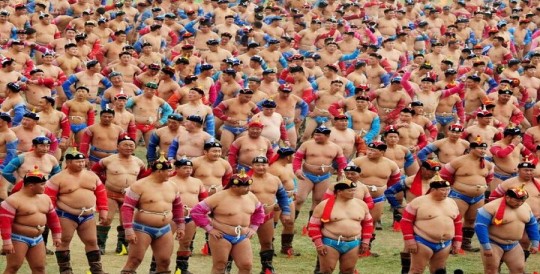
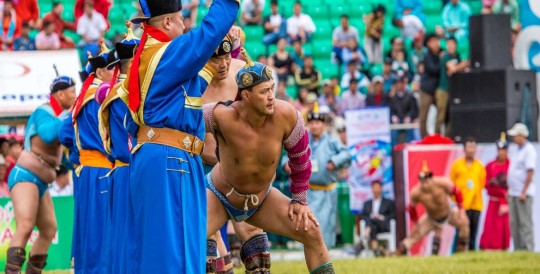
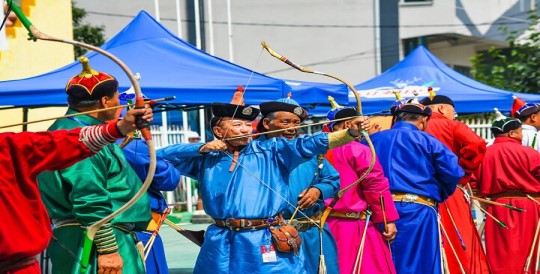
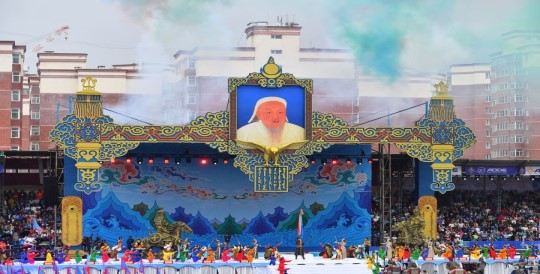
"Naadam" Festival
in July 11-12-Click Here for "Naadam" Festival Package Tours
However, July and August are the two wettest months of the
year. The season lasting from November to March is cold.
The best time to visit the Gobi is June or September as
temperatures aren't so hot then. For more information about
Climate and more, please visit our web page at:
Info about Mongolia
|
|
|