|
|
Situation |
Geography |
Language |
Political-Administrative Div |
Climate |
Time |
Economy |
Government and Relations |
Transport |
Public Holidays |
Religious |
Flag |
|
Situation
|

Mongolia opened its door to tourism in
1991. Mongolia is situated in the centre
of the continent of Asia Central (between Russia and China)
and covers an area of 603, 899 sq. miles (1.566.5100km²,
about three times the size of France), making it the 18th
largest country in the World. Mongolia lies between 87°44'E
and 119°56'E Longitude and between 41° 35'-44'N
and 52°09'N Latitude in the North of Central Asia.
Latitude: 47° 55' North
Longitude: 106° 53' East .
The average altitude is 1580m (5180ft) above sea level.
top
|
Political-Admin.Div |
The territory of
Mongolia is divided into 21 aimags (or provinces)-with four
independent municipalities: Ulan Bator, Darkhan-Uul (included
Darkhan city), Orkhon (included Erdenet city), Gov-Sumber
(included the free trade zone town of Choir).The aimags
are further divided into a total of 310 sums, or districts.
The territory of Ulan Bator capital is 1,815 sq. miles (4,700km²)
with 9 districts. Ulan Bator was founded in 1639. Population
of Ulan Bator: 812, 500. Mongolian Population:
2,675,000 (July 2000 est.).
top
|

Geography |
Mongolia's
geography is very diverse, including high mountains.The
Mongol Altai Nuruu are permanently snowcapped, and their
highest peak, Tavanbogd Uul (4370m/14,350ft), has a magnificent
glacier that towers over Mongolia, Russia and China. Others
peaks are Otgon Tenger: 4021m and Mukh Saridag: 3461m. Mongolia's
geography is including boundless steppes, vast valleys,
rivers (4000, rich in fish), lakes (16 large lakes) and
the Gobi desert. The southern third of Mongolia is dominated
by the Gobi Desert. Most of the rest of Mongolia is grassland,
home to Mongolia's famed takhi horses, which Genghis Khan
used so successfully in his wars of conquest.
top
|
Climate
|
Temperatures
vary from 30°C in summer to -50°C in the
winter. The Mongolian Climate is one of extremes - hot summers
and freezing cold winters. Known as the 'Land of Blue Skies',
it has over 260 sunny days each year. The winter is long
and cold with temperatures often well below -30° Centigrade.
Despite these temperatures, the blue winter sky makes it
often feel warmer. There is very little snowfall but it
and ice can remain for several weeks at a time. The rainy
season is from July to September, but the showers are often
brief. The summer is a very pleasant time because, although
temperatures can reach +40° Centigrade, the air is very
dry. The Gobi usually has the hottest temperatures. Summer
evenings can be cool because of Mongolia's high altitude.
The Spring is a time of strong winds, especially difficult
in the sandy areas of the Gobi.
top
|
Language
|
Khalkh
Mongol is the official Mongolia language (is a
member of the Ural-Altaic family of languages, which includes
Finnish, Turkish, Kazak, Uzbek and Korean). Since 1944,
the Russian Cyrillic alphabet has been used to write Mongolian. People:
Khalkh Mongols (86%), Kazaks (2%), Chinese (2%), Russian
(2%), about a dozen other ethnic groups. Kazak is spoken
by 5% of the population. There are also many Mongolian dialects.
The most spoken foreign languages are English, Russian,
Chinese, Japanese and Germany.
top
|
Time |
Time
Difference: Mongolia is GMT + 8 hours ahead
of Greenwich Mean Time in winter and 9
hours ahead in summer. Mongolia still puts forward
its clocks by 1 hour in the summer months. The three western
aimags of Mongolia , Uvs, Bayan Ulgii and Khovd are one
hour behind Ulaanbaatar and the rest of Mongolia,
GMT+7. UTC is Coordinated Universal Time, GMT is Greenwich
Mean Time.
The World Clock:
http://www.timeanddate.com/worldclock/city.html?n=720
top
|
Economy
|
Mongolia's
economy is centered on agriculture and mining. Mongolia
has rich mineral resources, and copper, coal, molybdenum,
tin, tungsten, and gold account for a large part of industrial
production. There are currently over 30,000 independent
businesses in Mongolia, chiefly centered around the capital
city [citation needed]. The majority of the population outside
urban areas participate in subsistence herding; livestock
typically consists of sheep, goats, cattle, horses, and
Bactrian camels.
Agricultural crops include wheat, barley, vegetables, and
other forage crops. GDP per capita in 2005 was
$1,900 . Although GDP has risen steadily since 2002 at the
rate of 6.2% in an official 2005 estimate, the state is
still working to overcome a sizable trade deficit. A massive
($11 billion) foreign debt to Russia was settled by the
Mongolian government in 2004 with a $250 million payment;
this reduced value was accepted due to Despite growth, the
proportion of the population below the poverty line is estimated
to be 36.1% in 2004, and both the unemployment rate and
inflation rate are high at 6.7% and 10.9%, respectively.
Traditional based on livestock breeding (camels, bovine,
goats, horses and sheep), mining (coal, copper, gold, uranium).
Total livestock population: 26.1 million (sheep:11.9 million,
goats: 9.6 million, horses: 2.2 million, cattle: 2.1 million,
camels: 285.200).
Major industries: Copper, livestock, cashmere,
wool, meat. Major trading partners: Russia (35%), China
(21%), South Korea (12%), Japan (7%), Germany(5%), Hong
Kong (4%), and others (16%).
top
|

Govern.,
Foreign relations
|
Parliamentary
with a president elected every 4 years. Mongolia's president
has a symbolic role.
Mongolia's Constitution provides three requirements for
taking office as President: the individual must be a native-born
Mongolian, who is at least 45 years of age, and who has
resided in Mongolia for five years prior to taking office.
The current President is Mr. Nambaryn Enkhbayar.
The State Great Hural Mongolia uses a unicameral parliamentary
system in which the president has a symbolic role and the
government chosen by the legislature exercises executive
power. The legislative arm, the State Great Hural, has one
chamber with 76 seats and is chaired by the speaker of the
house.
Declared independence from China: in
July 11, 1921
Foreign relations and military: Mongolia maintains
friendly relations with the Russia, China, United States,
Japan, North Korea, South Korea, European Union, Cuba, and
virtually all countries in the world. It has initiated large
foreign investment initiatives and encouraged foreign investment.
|
Transport
|
GETTING
TO MONGOLIA:
Transport to or from Mongolia is usually by air or train.
MIAT Mongolian Airlines (OM) is Mongolia's
national airline, based in the capital, Ulan Bator. It operates
a domestic route network and international scheduled services
from its main base at "Chinggis" Khaan International Airport.
Flights are run by MIAT (Mongolian International
Air Transport) to:
Japan: Nagoya (Chubu Central International
Airport) [summer only].
Osaka (Kansai International Airport) [summer
only].
Tokyo (Narita International Airport).
South Korea: Seoul (Incheon International
Airport).
Russia: Moscow (Sheremetyevo International
Airport).
Irkutsk: (Irkutsk International Airport).
China: Beijing (Beijing Capital International
Airport).
Germany: Berlin (Tegel International Airport).
By 1992, MIAT had acquired a Boeing 727-200 jet from Korean
Air with one more following in 1994. The Boeing 727 jets
were later discharged. An Airbus A310 and Boeing 737 were
later acquired by MIAT. Later on in 2003 through 2005 MIAT's
Antonov fleet was discharged because they were over their
warranty, which led to the creation of Aero Mongolia.
Aeroflot, Korean Air and Air China are
also operating flights.
-Korean Air flies from LAX-Seoul to Ulaanbaatar
($1,740; www.koreanair.com).
-Mongolian Airlines: Purchasing domestic
flight tickets through Miat Mongolian Airlines (www.miat.com/)
can be tricky; your best bet is to book through an outfitter.
-Air China (China): http://www.airchina.com.cn/-In
Chinese language
(http://www.fly-airchina.com)-In
English language (Air China flies from LAX to Beijing to
Ulaanbaatar).
-Aeroflot (Russian Airlines): (www.aeroflot.com)
The
international Mongolian carrier is MIAT, which some wags
claim stands for 'Maybe I'll Arrive Today'. Delayed and
cancelled flights are common partly due to frequent poor
weather conditions and to internal problems. A
press conference was held on 17 November, 2004 to announce
some changes in the management team. The management team
are still awaiting a result from the government regarding
to the domestic services and for the new prices , which
at the moment MIAT is running at a loss. If MIAT is not
allowed to charge more to make a profit, the domestic service
is doomed (from Mongol Messenger Newspaper).
International airport: Ulan Bator (ULN)
airport is 15km (9 miles) from the city. Taxis are also
available (travel time - 35 minutes). Airport facilities
include a bank, duty-free shops and a restaurant.
Rail:
Ulaanbaatar is linked to the Russian Federation and China
by the Trans-Mongolian Railway. An express train runs once a
week between Moscow, Ulan Bator and Beijing. Trains on international
routes have sleeping and restaurant cars. There are also
other weekly trains from Ulan Bator to Beijing and Ulan
Bator to Moscow.
Border
crossings are at Erlian-Zamyn-Üüd on the Chinese-Mongolian
border, and Naushki-Sukhbaatar on the Russian-Mongolian
border. Some travellers have reported crossing into Mongolia
from Russia and China by jeep or bus, but technically this
is still illegal. At present, there are problems reported
on buying train tickets in and to Ulan Bator for the Chinese
Train. Although, the trains certainly stop in Ulan Bator,
tickets are only being sold to Chinese or Russian destinations.
The Mongolian Road Conditions/Maintenance: Poor
top
|
Public Holidays
|
New
Year's Day - 1st January,
Tsagaan Tsar (Lunar New Year) - 13-14 February,
Mothers' and Children's Day - 1st June,
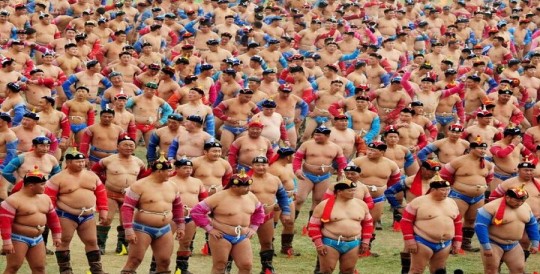
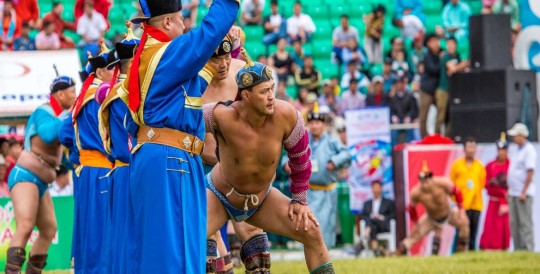
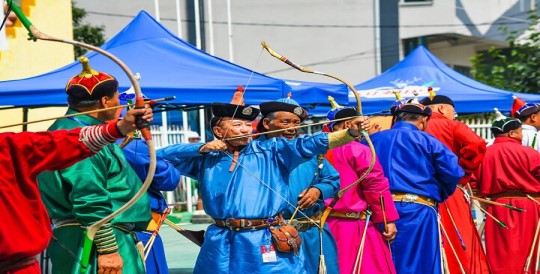
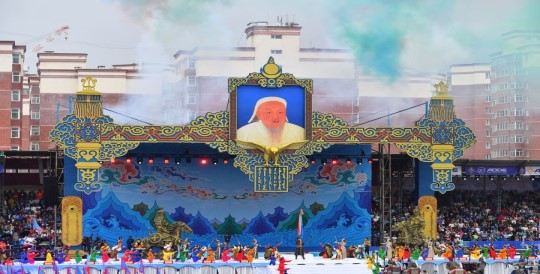
National Holiday-Naadam - 11th to 13th July:
Click here for more details
Independence Day - 26th November.
top
|
Religious
|
Tibetan
Buddhist, Muslim, and Shamanism. Since 1992, Catholic is
part of the religious life of the young Mongols .
top
|
Flag
|
The
National Flag of Mongolia is red with a vertical blue stripe
down the middle. On the left hand red stripe of the flag
is a yellow Soyombo . The colors are symbolic. Red is the
color of fire symbolizing progress and prosperity while
the blue represents; the color of the sky, meaning peace
and eternity.
| |
|