MONGOLIA

Mongolia

Mongolia is a country where nature still sets the rhythm of life. Vast steppes, sacred mountains, and golden deserts coexist with a nomadic culture that has preserved its traditions intact. It is a land of silence and vastness, where the sky seems endless and hospitality is an essential part of its identity.

General information about the country

ÁREA

1,564,120 km2 (603,910 mi2)

Population

3,700,000 at the beginning of 2025.

ISO code & Internet Domain

MN - mm

Capital

Ulán Bator (ULB)

Density

2.2 per km² (5.6 people/mi²)

Driving

On the right-hand side

Code

976

Median Age

27.1 years

Electricity

230 volts Ac, 50Hz

Currency

The currency of Mongolia is the Tugrik (₮ or MNT). Banknotes in circulation: 10, 20, 50, 100, 500, 1000, 5000, 10,000, 20,000 Tugrik (since autumn 2006).

Life Expectancy

68.3 años (65.9 hombres y 70.9 mujeres)

Ethnic Groups

95.35% Mongols // 3.86% Kazakhs //
0.8% Others

Bandera Mongolia

Flag & Location

Mongolia is located in the Heart of Central Asia, a landlocked country with no access to the sea. It is one of the least-known countries in the world, from a tourism perspective. However, the country offers beautiful landscapes for those who love adventure and nomadic cultures. Mongolia is the perfect destination for adventure and nature travel. It also features peaks and summits, ideal for climbing enthusiasts.
Mongolia lies between 87°44’E and 119°56’E longitude and between 41°35′-44’N and 52°09’N latitude in Northern Central Asia. Its average elevation is 1,580 m above sea level. Mongolia is bordered by the Russian Federation to the North and the People’s Republic of China to the South. The total area is 603,899 square miles (1,566,500 km², nearly 3 times the size of France). It is the 18th largest country in the world.
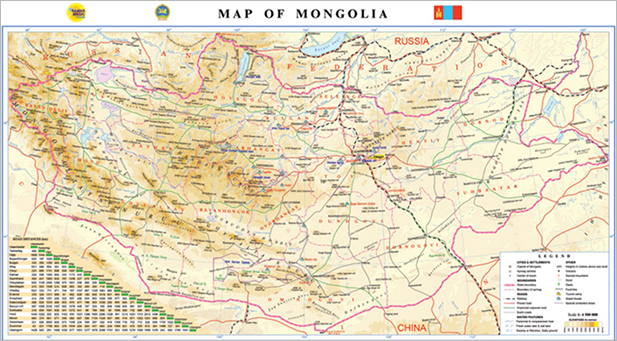
Mapa Mongolia
Unique journeys
to Mongolia

Start planning your trip — we’re here to guide you.

Share your ideas with us and we’ll help shape the experience that’s right for you.

Useful information

Official Languages:

The official language of Mongolia is Khalkh Mongol (Jalj Mongol), a member of the Ural-Altaic language family (which also includes Hungarian, Finnish, Turkish, Kazakh, Uzbek, Korean, etc.). Since 1944, the Russian Cyrillic alphabet + two additional characters has been used to write Mongolian. Other widely spoken languages in Mongolia include English, Korean, Russian, Japanese, and Chinese.
The Mongolian people are composed of Khalkh (Jalj) Mongols (86%), Kazakhs (2%), Chinese (2%), Russians (2%), and other smaller ethnic groups. The Kazakh language is spoken by about 5% of the population.

Time Zone:

In summer: UTC +8 hours with respect to GMT. During the rest of the year: UTC +7 hours. There are three provinces in western Mongolia (Khovd, Uvs, and Bayan Ulgii): UTC +7 hours in summer.

Safety

Mongolia is a safe country for visitors, as there are no drugs, no muggings, and no weapons. However, as everywhere, visitors should be aware of pickpockets, for example at the Central Post Office, markets, shops, on public transport, at Gandan Monastery, the black market, during the Naadam Festival celebrations, and in places with large crowds.

Practical information

Tibetan Buddhism, Shamanism, Muslims in the far West, and Christians.

No vaccinations are required to travel to Mongolia.

Mongolia is the land of the steppes and true nomads. It currently has more than 70 million head of sheep, goats, cattle, horses, camels, yaks, and other animals.

Mongolia Airlines (OM), Turkish Airlines (TK), Air China (CA), Korean Air (KE), United Airlines.

The Trans-Mongolian is the main rail connection between Mongolia and its neighbours.

The best months to travel to Mongolia are from mid-May through June, July, August, and September. Mongolian nomads use sport as an excuse to gather during the Naadam Festival, which is the National Holiday celebrating independence, and it takes place on July 11 and 12.

As a nomadic people, Mongols live in felt tents. This type of dwelling is known as a GER—it is a felt tent that adapts perfectly to the continental climate of the country and the nomadic life of its inhabitants. A complete Ger was discovered in a tomb in the mountains of Khenti Province, dating back to the 13th century. The GER is one of Mongolia’s national symbols. It is circular in shape and built with small wooden frames to support the fabric walls. The doors always face south; at the back and to the left is the area reserved for guests; at the back is the khoimor, the space for elders and family treasures, and beyond that is the family altar, with Buddhist images and family photographs. A medium-sized GER offers a covered area of about twenty square meters. Inside each of these tents, the hearth is the most important feature. Located in the center, it has not only practical value but also symbolic significance, as it represents the relationship of the inhabitants with their parents, ancestors, and predecessors. The fire is fueled with dung; periodically, these tents are moved using ox-drawn carts, or completely dismantled for relocation.
The word GOBI means “desert” in Mongolian. The Gobi Desert is full of life. It is mostly made up of steppes and plains with vegetation for grazing, and only about 3 percent of its surface area is sand. It is the largest protected area in Asia, designated as a UNESCO Biosphere Reserve in 1991. The region has also revealed important fossil sites. Also noteworthy are the mountains of eastern Gobi, which are home to some of the world’s last desert bears, as well as several species of camels, horses, and reptiles. It is considered one of the largest and most important deserts, or desert regions, in the world. It is bordered by the Altai Mountains and Mongolian steppes to the north.