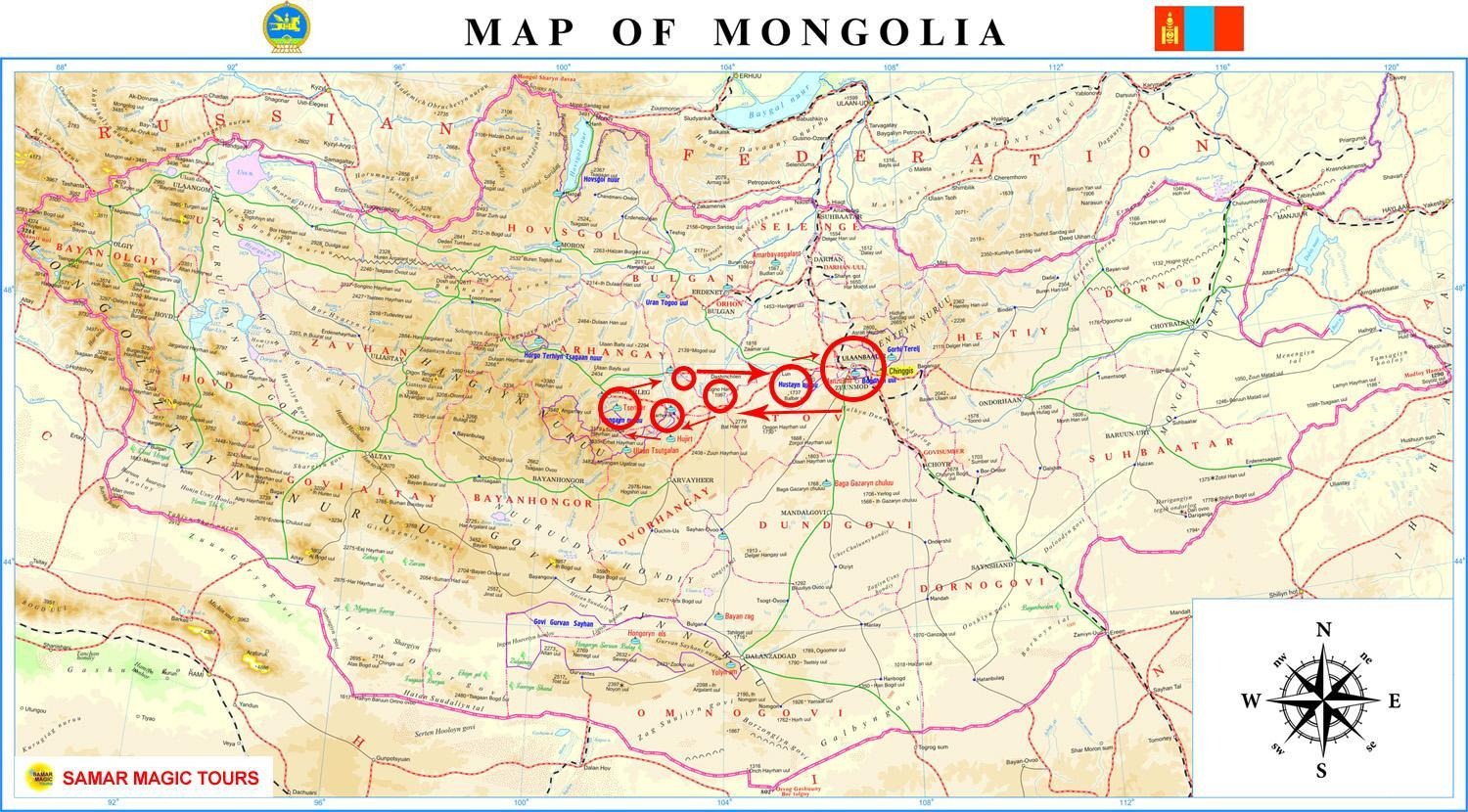
We will begin the route at Ulaanbaatar’s New “Genghis” Khan International Airport (inaugurated on July 3, 2021, located 52 km/32.3 miles away, approx. +2-3 hours’ drive depending on traffic), capital of Mongolia, with a warm welcome from the Samar Magic Tours team. This is one of the most fascinating routes in Mongolia. Next, we will depart northeast to visit the Equestrian Statue of Genghis Khan, a stainless-steel monument standing 40 meters tall. At the base of the statue, visitors can see a replica of the legendary Golden Whip of the Great Khan. Tourists can take an elevator inside the statue. The exit is at the level of Genghis Khan’s thigh, from where one can walk to the horse’s head and enjoy a panoramic view of the steppe. We will also visit a small Bronze Age Museum, located in the basement of the statue. Departure continues northeast to Gorkhi/Terelj National Park, located 1,600 meters above sea level, with towering granite rocks from the Mesozoic era, mountains, steppes, alpine forests, and large rock formations of unusual shapes such as Turtle Rock. Declared a National Park in 1993, it covers an area of 300,000 hectares. Afterward, we will head west to attend an Authentic Mongolian Nomadic Show, which demonstrates the traditional lifestyle of Mongolian nomads, including the herding and use of five types of livestock, moving from one place to another with ox carts, yaks, camels, and horses. We will then continue westward to Karakorum (Central Mongolia), the former capital of the Mongol Empire, where “Genghis´´ Khan began construction in 1220 (later destroyed by Manchu soldiers). Here we will visit the Monument to the Mongolian States, built in 2004 on a hill overlooking Karakorum (Kharkhorin) and the Orkhon River. The monument features a large stone ovoo (shamanic cairn) with nine poles rising from its top, mounted on a stone and concrete platform, and surrounded by three circular walls. The outer walls are decorated with colourful mosaics depicting maps of three empires:
- The Xiongnu Empire, a confederation of nomadic tribes inhabiting the steppe from the 3rd century BC to the 1st century AD.
- The Turkic Khaganate, established by the Göktürks in 682 and lasting until 744.
- Finally, the Mongol Empire, founded by Genghis Khan in the 13th century.
The site combines imperial symbolism with shamanic traditions. Offerings of vodka, milk, tea, rice, and other foods are often left at the ovoo, attracting birds and even passing herds of sheep and goats. Animal skulls can also be found scattered nearby, adding to the surreal atmosphere. Located in Karakorum (then the capital under Ogedei Khan, successor of “Genghis´´ Khan), this monument also provides a panoramic viewpoint over the Orkhon River valley.
Next, we will visit the Erdene Zuu Monastery (Hundred Treasures), the Turtle Monument, and the Karakorum Museum to view relics of the Mongol Empire. With its 108 stupas, walls, and temples, Erdene Zuu (built in the 16th century) was the most important Buddhist lamasery. Today, it remains a striking complex covering 400 square meters, surrounded by the steppe. Construction was continued by Ogedei Khan after Genghis Khan’s death. Forty years later, Kublai Khan (grandson of Genghis and host of Marco Polo) moved the imperial capital to Beijing (Yuan Dynasty). In the afternoon, we will visit the Khushuu Tsaidam Memorials in the Orkhon Valley, erected in honour of Turkic princes Bilge Khan and Kul Tigin (8th century), with Orkhon inscriptions considered the most impressive monuments of the Göktürk Empire. Later, we will depart to Lake Ugii, a paradise for migratory birds during April, May, and summer. These 25 km/16-mile-wide valleys is also home to herds of yaks, sheep, horses, and cattle. We will visit a small museum dedicated to the local flora and fauna, with opportunities for birdwatching. Return to Karakorum. We will then continue to the Elsen Tasarkhai Dunes (also known as the Bayangobi Desert), stretching 80 km/50 miles through a picturesque valley. Here we will hike, climb the dunes, photograph the landscapes, and enjoy an included camel trek across the golden sands.
Much of the Mongolian population remains nomadic, moving across the land with their Gers and herds of livestock. Encounters with these families and their way of life are an unforgettable experience. To fully appreciate this journey, travellers must embrace the conditions of Mongolia, set aside preconceived expectations, and remain open to all that this country can offer.