Mongolia is the Land of the Eternal Blue Sky, a country of great contrasts, possessing an immense natural reserve. Nothing limits the vision; from any point, you can only see the horizon, the green of the steppe plain and the intense blue of the sky. Both colors merge so far away that it is possible to perceive the curvature of the earth.
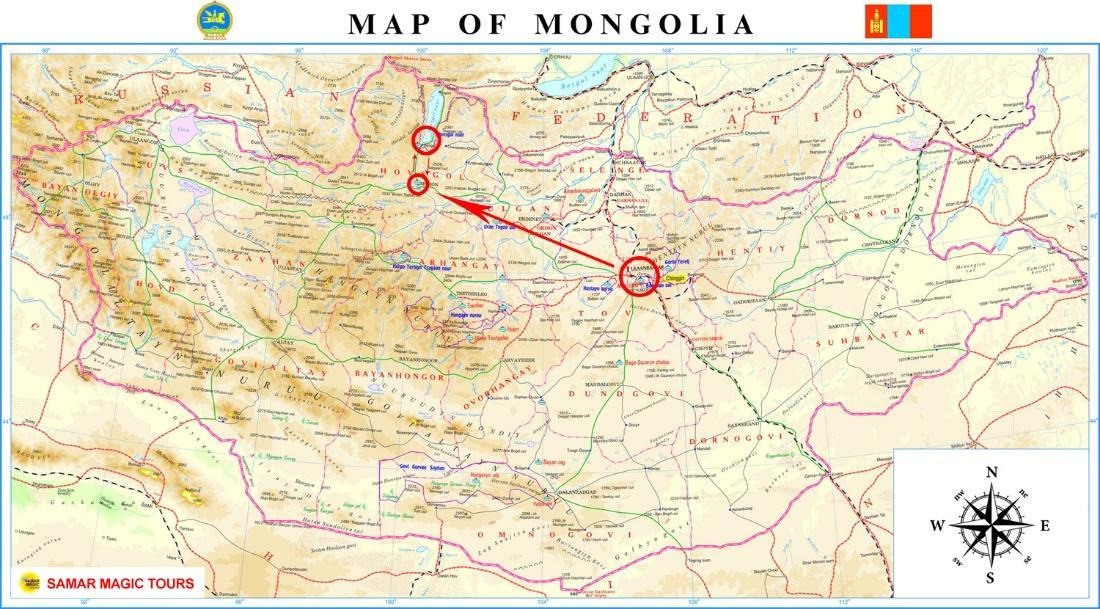
We will begin the route in Ulaanbaatar, the capital of Mongolia, with a welcome by the Samar Magic Tours team. Next, depart westward to attend an Authentic Mongolian Nomadic Show, demonstrating the traditional way of life of the nomads of Mongolia: the breeding and use of five types of livestock moving from one place to another, using ox carts, yaks, camels, and horses.
At the scheduled time, meeting with Samar Magic Tours at the hotel reception (*rooms must be vacated by 12:00 noon). Transfer to Ulaanbaatar’s New “Genghis” Khan Airport. Included flight Ulaanbaatar/Murun. Domestic flights are subject to final schedule. Meeting at the local Murun airport with the local vehicle and private transfer to the Great Lake Khuvsgul National Park, crossing through the city of Murun, capital of Khuvsgul province (a town with only 28,000 inhabitants, at an elevation of 1283m above sea level).
The Great Lake Khuvsgul, on the border with Siberia, is the Paradise of Mongolia, also called the Mother Lake due to its immense beauty. This is a magnificent and vast blue lake, surrounded by dense Siberian forests and abundant wildlife. The water is so pure it is perfectly drinkable; mountains are everywhere (around 2,000), fresh pine forests, and graceful yaks and horses galloping elegantly. Here we will meet the Tsaatan, better known as the Reindeer Nomads (some are powerful shamans), since they dedicate themselves mainly to raising these animals for their meat and hides.
Mongolian shamanism, broadly understood as the popular religion of Mongolia, sometimes also called Tengrism, refers to the ethnic animistic and shamanistic religion historically practiced in Mongolia.
Tuvá became independent in 1921 when Mongolia achieved independence. The Tsaatan people fled the city of Tuvá after the outbreak of World War II, when Tuvá was annexed to the Soviet Union in 1944. The tribe settled in Mongolia due to food shortages during the war, confiscation of domestic animals by the Soviet Union, among other reasons.
The Tsaatan practice shamanism, a religion based on the worship of nature. The tribe believes that the souls of their ancestors live in the forest, guiding the living. They revere shamans, whom they call “Boo”, and they have many sacred books that they follow in daily life practices, such as hunting or warding off the rain.
In the second part of this great journey, departing northeastward to the Equestrian Statue of Genghis Khan, a 40-meter (~133.3 ft) tall figure on horseback. The statue points symbolically east, toward his birthplace. It stands atop the Genghis Khan Statue Complex, a 10-meter-high (32 ft 10 in) visitor center with 36 columns representing the 36 khans from Genghis to Ligdan Khan. Visitors can ascend through the horse’s chest and neck up to the head, where a panoramic view awaits. Next, depart to Gorkhi-Terelj National Park, located northeast at 1600m above sea level, with high granitic rocks from the Mesozoic, mountains, steppes, alpine forests, and large rock formations of curious shapes such as Turtle Rock and others.
Then, departure to Karakorum (Central Mongolia), the ancient capital of the Mongol Empire, where “Genghis” Khan began construction of the capital in 1220 (later destroyed by Manchu soldiers). We will visit the Monument to the Mongol States, located on a hill overlooking the city of Karakorum (Kharkhorin), on the banks of the Orkhon River. Built in 2004, the monument consists of a large pile of stones (a shamanic ovoo) carefully assembled into a cone, with nine poles protruding from the top. This structure stands on a stone and concrete platform, surrounded by three walls representing three sections of a circle. The outer sides of these walls feature three colorful mosaics, each representing one of the empires:
- The Xiongnu Empire, a confederation of nomadic tribes that lived on the steppes from the 3rd century BC to the 1st century AD.
- The Turkic Khaganate, established by the Göktürks in 682, which lasted only until 744.
- Finally, and most famously, Genghis Khan founded the Mongol Empire of the 13th and 14th centuries.
The iconic place of the Mongol Empire in culture, combined with the shamanic symbolism of the ovoo in the monument’s center, encourages people to leave offerings of vodka, milk, tea, rice, and other delicacies, which inevitably attract birds and even herds of goats and sheep passing by. Around the monument, animal skulls can also be found, completing the surreal scene. It is no coincidence that the Imperial Map Monument is located in Kharkhorin, since this city (then called Karakorum) was the capital of the Mongol Empire under the successor of “Genghis Khan,” Ogedei Khan. The monument is also a great viewpoint to contemplate Kharkhorin and the Orkhon River, imagining how this collection of dirt roads and low-rise buildings might have looked in its days of glory.
Afterwards, visits to the Erdene Zuu Monastery (Hundred Treasures), the Turtle Monument, and the Karakorum Museum, to see the relics of the ancient Mongol Empire capital. The Buddhist Erdene Zuu Monastery, with its 108 stupas and the first Buddhist lamasery (16th century), was the most important religious center. Today, it remains an impressive sight, with its walls, stupas, and temples occupying 400 square meters, surrounded by the steppe. Construction was continued by his son Ogedei Khan after his death. Forty years later, Kublai Khan (grandson of Genghis Khan and host of Marco Polo) moved the capital of the Empire to Beijing (Yuan Dynasty).
We then continue the route toward the Elsen Tasarkhai dunes (also known as the Bayangobi Desert). These desert sand dunes stretch for 80 km in a beautiful valley. Opportunities for hiking, dune walking, and photography abound. An included excursion takes us across the dunes on the backs of Bactrian camels. Finally, return to Ulaanbaatar for last-minute shopping.
Much of the Mongolian population is still nomadic, moving from one place to another on horseback, camel, or yak, with their Gers and herds. An occasional encounter with one of these families and their way of life is an unforgettable experience. We emphasize that, to truly enjoy this, one must accept in advance the conditions outlined above, let go of preconceived notions of how things “should be” according to our mentality, and remain open to what this country has to offer.