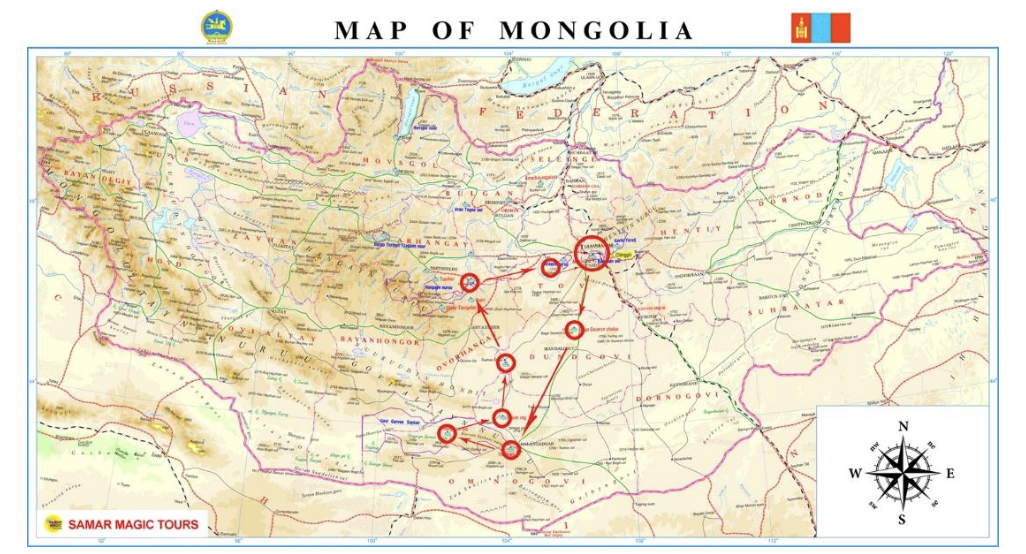
We will begin the route at the new “Genghis” Khan airport of Ulaanbaatar (inaugurated on July 3, 2021, located 52 km/32.3 miles, +2 hours’ drive), capital of Mongolia, with reception by the Samar Magic Tours team. This is the grand and most fascinating route of Mongolia, covering over 2,500 km / 1,553.4 miles.
Next, departure heading N/E to visit the Great Equestrian Statue of Genghis Khan. At the base of the statue, visitors can see a replica of the legendary Golden Whip of the Great Khan. Tourists may take an elevator inside the statue. The exit is at the height of Genghis Khan’s thigh, from where you can walk up to the horse’s head for a sweeping panorama of the steppe. We will also visit a small Bronze Age Museum located in the basement of the Equestrian Statue.
Departure N/E to Gorkhi/Terelj National Park, located at 1,600 m above sea level, with high granite formations from the Mesozoic, mountains, steppes, alpine forests, and curious Mesozoic rock shapes such as Turtle Rock. It lies at the foot of the Khenti Mountains, the region where Genghis Khan was born. Declared a National Park in 1993, it covers an area of 300,000 hectares.
We continue heading South towards the rock formations of Baga Gazarin Chuluu (meaning “rocks” in Mongolian), a cluster of granite formations in the Middle Gobi, 1,768 m high, 15 km long, and 10 km wide. It is said that Genghis Khan camped here during one of his journeys. Arrival and accommodation. After some rest, excursion to the Ruins of the Sum Khunkh Burd Temple, built in the 10th century. In Central Gobi, we will explore Tsagaan Suvarga (White Stupas or White Pagodas), located about 426 km (265 miles) from Ulaanbaatar, and 30 km east of the main Ulaanbaatar–Umnugobi road (South Gobi). This colorful limestone formation rises 30–60 m (98–196 ft) in height and stretches 400 m (1,312 ft) long, once forming part of an ancient seabed where marine fossils and shells can still be found. Its colors are especially striking in the morning and evening light. The formation is named Tsagaan Suvarga because its shape resembles ancient Buddhist stupas or pagodas. Walking trails allow visitors to descend and ascend through the cliffs. Excellent opportunities for photography.
Next, the route continues southbound to the fascinating Gobi Desert. We will explore Yolyn Am Canyon (Vulture’s Gorge) in “Gobi Gurvan Saikhan” National Park (“Three Beauties” of the eastern, middle, and western ranges), fossil sites of giant dinosaurs, and the stunning sand dunes known as “Moltsog´´. We will also visit a local family with Bactrian camel herds. Excursion included: riding on the backs of Bactrian camels.
In Central Mongolia, we will visit Karakorum, the ancient capital of the Mongol Empire of Genghis Khan. Here we will explore the Orkhon Valley, declared a UNESCO World Heritage Site in 2004 for representing the evolution of nomadic pastoral traditions for more than two millennia. We will also discover the beautiful Lake Ugii, a perfect site for birdwatching. Birds include swans, geese, cranes, ducks, pigeons, storks, and other migratory species that gather in this area.
Much of the Mongolian population remains nomadic, moving from place to place on horseback, camel, or yak, with their Gers and herds. The occasional encounter with one of these families and their way of life is an unforgettable experience. To truly enjoy this journey, one must accept in advance the conditions described above, let go of preconceived notions of how things “should” be, and remain open to what this country has to offer.