MINIMUM DURATION: 16 days / 15 nights
ROUTE CODE: SMT-GNF-16D
START/END POINT: Ulaanbaatar, Mongolia (flights not included).
SPECIAL GROUP DEPARTURE NAADAM FESTIVAL: June 28 – July 13. This falls during Mongolia’s high and peak season, when hotels and services are in high demand and often fully booked.
MINIMUM GROUP SIZE: 6 to 10 adults or more participants.
MAXIMUM GROUP SIZE: +16 participants.
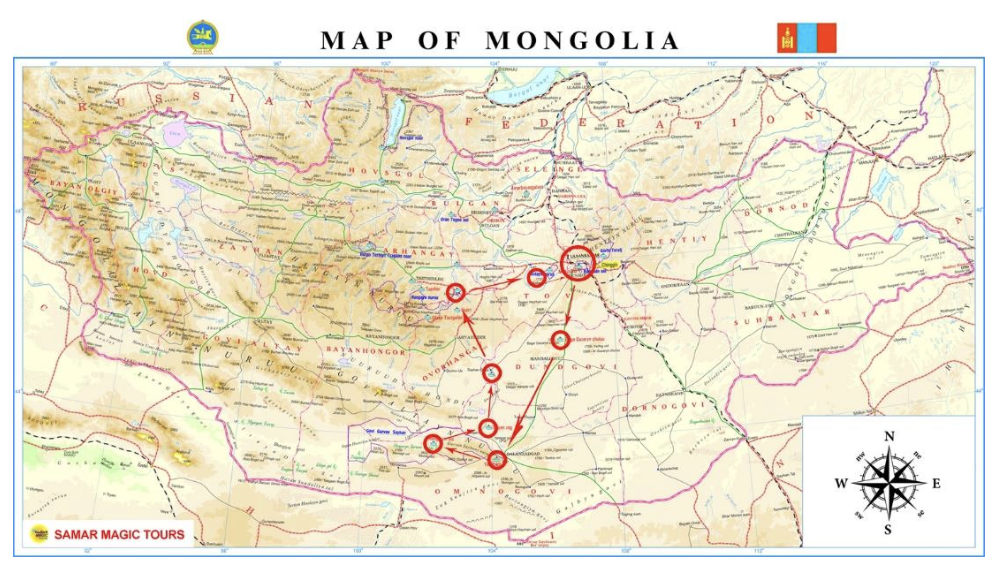
TRIP DESCRIPTION: We will begin the journey at the new “Genghis Khan” airport in Ulaanbaatar (opened on July 3, 2021, and located 52 km / 32.3 miles away—a 2-hour trip), the capital of Mongolia, where you will be welcomed by the Samar Magic Tours team. This is the most compelling major route through Mongolia, covering over 2,500 km / 1,553.4 miles.
Next, we head northeast to visit the Great Equestrian Statue of Genghis Khan. At the base of the statue, visitors can see a replica of the Great Khan’s legendary golden whip. Tourists can take an elevator up inside the statue, emerging near Genghis Khan’s crotch; from there, one can walk to the horse’s head for a sweeping panoramic view of the steppe. We will also visit a small Bronze Age museum located in the basement of the statue. Afterward, we depart for Gorkhi-Terelj National Park, situated at an altitude of 1,600 meters above sea level. The park features towering Mesozoic granite formations, mountains, steppes, and alpine forests, including striking rock formations with curious shapes—such as “Turtle Rock” . It lies at the foothills of the Khentii Mountains, the region where Genghis Khan was born. Established as a national park in 1993, it spans an area of 300,000 hectares. We then travel south—in comfortable 4×4 Toyota Land Cruisers—toward the Baga Gazarin Chuluu rock formations (the name means “rocks” in Mongolian). This site consists of granite formations in the Middle Gobi, reaching an elevation of 1,768 meters and covering an area 15 km long by 10 km wide. It is said that Genghis Khan once camped here during one of his journeys. Upon arrival, we will check into our accommodation. After some time to rest, we will set out on an excursion to the ruins of the Sum Khunkh Burd temple. This temple was built in the 10th century. In the Central Gobi, we will explore
Tsagaan Suvarga (White Stupas or Pagodas) is located approximately 426 km (265 miles) from Ulaanbaatar, and 30 km east of the main Ulaanbaatar–Umnugobi (South Gobi) road. It is a colorful limestone formation, 30–60 m (98–197 ft) high and 400 m (1,312 ft) long, which was once an ancient seabed where visitors can still find marine fossils and shells. Its colors are particularly striking in the morning and evening. Tsagaan Suvarga—meaning “White Stupa”—gets its name from its resemblance to Buddhist stupas or pagodas. There are trails that allow you to hike down into and back up through the cliffs, offering a great opportunity to photograph the site’s vibrant colors during the morning and evening hours.
Next, we head south toward the fascinating Gobi Desert. We will explore the “Yolyn” Canyon—or Vulture Gorge—within Gobi Gurvan Saikhan National Park (named for the “three beauties” of its eastern, central, and western mountain ranges), visit sites where fossils of giant dinosaurs have been discovered, and see the massive “singing” sand dunes known as “Khongor.” We will also visit a family that raises Bactrian camels, with the opportunity to take a ride on one. We will explore the “Flaming Cliffs” of Bayanzag; it was here in 1922 that Roy Chapman Andrews, an American paleontologist and staff member at the American Museum of Natural History in New York, first discovered dinosaur eggs measuring 4 to 6 inches. Bayanzag is known as the “Flaming Cliffs” due to its striking colors and unique formations. Enjoy the sunset at these legendary cliffs, which glow intensely at both dawn and dusk. In the central region of Mongolia, we will visit Karakorum—the ancient capital of Genghis Khan’s Mongol Empire—and the Orkhon Valley, which was designated a UNESCO World Heritage Site in 2004 for representing the evolution of nomadic pastoral traditions over more than two millennia. We will also explore the beautiful Lake Ugii, an ideal habitat for birds; species such as swans, geese, cranes, ducks, pigeons, storks, and various other migratory birds can be found in this area.