Inbound Tour Operator with local Spanish-speaking guides and also with local English-speaking local guides, organizing Fishing Tourism in Mongolia since 1997, specialized in guided fishing adventures.
The Tsagaannuur–Renchinlhumbre Valley:
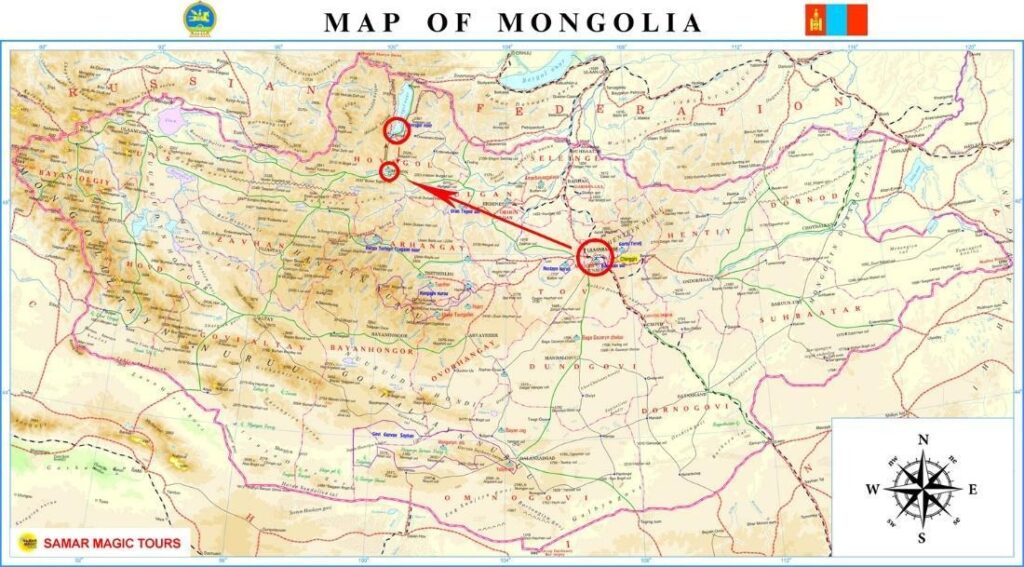
Located in the remote Siberian North, more than 1,000 km from Ulaanbaatar, on the border with Russia at the confluence of the Shishkid and Tengis rivers in the north of the country. An ideal place to achieve a trophy catch, with beautiful taimen and abundant smaller species. The surroundings, at 1,500 meters above sea level, are typical Mongolian taiga—and needless to say, spectacular. The Shishkid River is perfect for spinning fishing while the Tengis River is highly appreciated by fly fishermen. The exclusive fish species of the area and of Siberia is the Hucho Taimen, and they are huge beasts. The lures used to catch them imitate MICE and small ANIMALS. In their natural habitat, you will also find salmon, lenok (a type of local trout), and the rare grayling. Fishing in Mongolia offers a great challenge due to the remoteness of the terrain. The trip is extreme, and you are literally days away from “civilization.” It also provides excellent opportunities to combine fishing with cultural tours before or after, making it a great way to discover the richness of Mongolian culture and traditions together with local families.
Great Rivers in the Remote N/W Region of Mongolia: The Shishkid, Tengis, and Sharga rivers are located in the remote Tsagaannuur–Renchinlhumbre Valley, a strategic spot where the camp sits at the confluence of the Shishkid, Tengis, and Sharga rivers in the north of the country. This is a prime area for trophy catches, with spectacular taimen and plentiful smaller species. The surroundings, at 1,500 meters of altitude, resemble a Canadian landscape more than the typical Mongolian taiga—and needless to say, it is breathtaking. The Shishkid, Sarga, and Tengis rivers are perfect for spinning lure and fly fishing. Accommodations include tents (by the rivers), very simple wooden cabins, or gers (the traditional Mongolian dwelling made of felt, consisting of dormitories with three to four beds, etc.).
Hucho Taimen: A fish species from the Salmonidae family in the Salmoniformes order. Males can reach 200 cm in total length and weigh up to 100 kg. Reproduction takes place in May. Longevity: they can live up to 16 years. Strikes on flies and mouse or bird imitations are extremely violent, sometimes attacking three or four times in the same cast before finally taking the fly. They are famous for explosively attacking anything that dares to cross the water’s surface, including ducks, mice, squirrels, prairie dogs, grasshoppers, etc. For this reason, Mongolians call them the “Wolves of the Rivers.”
We have been pioneers in this fishing sport since 1997. We strongly promote catch and release fishing, as there are not as many Hucho Taimen left compared to the number of fishermen. Due to excessive fishing over the past 30 years in Mongolia, the Hucho Taimen population has significantly declined.
Fishing Season in Mongolia: The best fishing season in Mongolia is in September (Autumn). In October fishing is possible, but it is very cold, and the rivers begin to freeze.
In summer, fishing is prohibited in Mongolia, since Hucho Taimen and other species reproduce during April and May. It is also the rainy season, rivers run high and murky. High temperatures significantly reduce taimen activity. Winters in Mongolia are extremely harsh; in this northern region the rivers freeze completely, and vehicles can even drive across them.
Fishing for Hucho Taimen: This is very tough and demanding fishing, similar to steelhead or golden dorado fishing. Working hard all day to get five or six strikes and land one or two taimen per day is the norm. Covering as much water as possible each day is key. You must move a lot and fish fast. If the taimen are active and hunting, they will move three or four meters to take a fly as soon as they see it. If not feeding, you can pass the fly countless times right over their head and they won’t attack. The most widely used technique—because of the spectacular and violent strikes—is surface fishing with floating lines. The goal is to imitate a small rodent struggling to swim across the current. The fly drifts naturally downstream. Flies are almost exclusively mouse imitations, carefully designed in size and shape. Streamer fishing is also highly effective, especially in late autumn, when water temperatures drop, and the taimen slows down and remains closer to the bottom.
All fishing operations in Mongolia have special government permits to fish in these specific rivers.
Road Network in Mongolia:
Infrastructure is still under development. Most of the road network consists of gravel and dirt tracks, not paved. Total roads: 46,700 km. Paved: 1,000 km