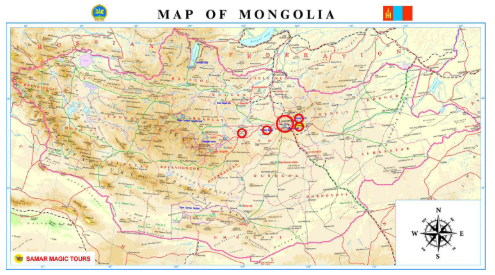
TOUR DESCRIPTION: We will begin the route at the new “Genghis” Khan Airport in Ulaanbaatar (inaugurated on July 3, 2021, located 52 km/32.3 miles away, approx. +2-3 hours’ drive, depending on traffic), the capital of Mongolia, where you will be met by the Samar Magic Tours team. This is one of the most fascinating routes in Mongolia. Next, we will head northeast to visit the Equestrian Statue of “Genghis” Khan. At the base of the statue, visitors can see the replica of the legendary golden whip of the Great Khan. Tourists can take an elevator inside the statue. The exit is at the level of Genghis Khan’s thigh, from where one can walk up to the horse’s head to enjoy a magnificent panorama of the steppe. We will also visit a small Bronze Age Museum, located in the basement of the Equestrian Statue of “Genghis” Khan. We will continue northeast to Gorkhi/Terelj National Park, located at an altitude of 1,600 meters above sea level, featuring high Mesozoic granite rock formations, mountains, steppes, alpine forests, and remarkable rock shapes such as the Turtle Rock. Declared a National Park in 1993, it covers an area of 300,000 hectares. Next, we will head west to attend an Authentic Mongolian Nomadic Show, which demonstrates the traditional lifestyle of Mongolia’s nomads—the livestock and use of the five types of livestock as they move from one place to another, using carts drawn by oxen, yaks, camels, and horses. We will then continue westward to legendary Karakorum, the former capital of the Mongol Empire, where Genghis Khan began construction of the capital in 1220 (later destroyed by the Manchu soldiers).On the return journey to Ulaanbaatar, we will visit the Elsen Tasarkhai sand dunes (known as the Bayangobi Desert). These desert sand dunes stretch over 80 km in a beautiful valley. There will be opportunities for hiking, walking across the dunes, and photographing the landscapes. An excursion is included to ride a Bactrian camel across the dunes.
Much of Mongolia’s population still lives as nomads, moving from one place to another on horseback, camel, or yak, with their Gers and herds. The occasional encounter with one of these families and their way of life is an unforgettable experience. We stress that, in order to truly enjoy this journey, one must accept the conditions outlined above, set aside preconceived notions of how things “should be” according to our own mindset, and remain open to all that this country can offer.