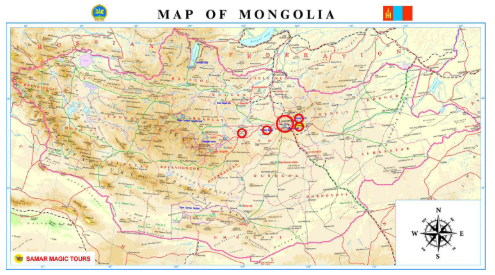
We will begin our journey at the new “Genghis” Khan International airport in Ulaanbaatar (inaugurated on July 3rd, 2021, located 52 km / 32.3 miles away, approximately a +2 hour drive depending on traffic), the capital of Mongolia, where you will be greeted by the Samar Magic Tours team.
This Mongolia Spiritual & Meditation Great Journeys with Samar Magic Tours focus on the experience of Tibetan Buddhism, combining the exploration of desert and mountain landscapes with visits to Mongolia’s three most important monasteries — the Gandan Monastery in Ulaanbaatar, the Erdene Zuu Monastery in Karakorum (Central Mongolia), and finally the Amarbayasgalant Monastery in the remote North.
History of the Erdene Zuu Monastery: Construction began in 1585 by order of Abtai Sain Khan, following the second introduction of Tibetan Buddhism in Mongolia and after a meeting in 1580 in which the Dalai Lama of the time instructed him to do so. Part of the materials used in its construction came from the ruins of Karakorum. The complex was considered complete nearly three centuries later with the construction of a surrounding wall. Each side of this wall measures 400 meters in length and contains 100 stupas, spaced about 15 meters apart. It was likely planned to have 108 stupas—a sacred number in Buddhism and the number of beads in a Buddhist rosary—though this total was never reached. The walls of the monastery’s temples were painted, and the Chinese-style roofs were covered with green tiles. From its earliest days, Erdene Zuu housed numerous temples, up to 1,000 resident monks, and around 300 gers (traditional Mongolian felt tents), where monks lived either inside or around the monastery walls. It suffered damage during the Manchu invasions of the 1680s, though even before then, Chinese pressure had led to a degree of neglect—just as had happened earlier to the old Mongolian capital and base of the monastery, Karakorum.
Several reconstruction projects followed: the first was led personally by Zanabazar upon his return in 1701, during which he also reconsecrated the temples; another began around 1760 and ended in 1796; and yet another, led by Mongolian architect Manzushir, started in 1806 and finished in 1814. After this last renovation, at the beginning of the 19th century, the complex contained 62 complete temples combining Chinese and Tibetan influences and was home to more than 1,000 lamas during its golden period.
In 1939, the leader Khorloogiin Choibalsan ordered the destruction of the monastery as part of a Stalinist purge that wiped out hundreds of monasteries across Mongolia, killed more than ten thousand monks, and sent many others to Siberia. Only five temples (including the current three main ones), a few small buildings, and the outer wall with its stupas survived. The remaining temples were converted into museums in 1947. It is said that this part of the monastery was spared due to Joseph Stalin’s intervention, reportedly linked to the brief visit of U.S. Vice President Henry A. Wallace’s delegation to Mongolia in 1944. Despite this devastation, a surprising number of statues, tsam masks, and painted scrolls were saved—buried in nearby mountains or hidden in locals’ homes. Even today, thefts occur, and in the early 2000s, alarms had to be installed following the disappearance of several statues. Erdene Zuu was only able to continue existing as a museum because the only monastery officially permitted to remain active in Mongolia at the time was the Gandantegchinlen Monastery in Ulaanbaatar. Even after its transformation into a museum, Erdene Zuu only reopened for this purpose in 1965, nearly twenty years later. This changed with the fall of communism in Mongolia in 1990, when the monastery was returned to the lamas, and Erdene Zuu once again became a place of worship. Today, it continues to function as an active Buddhist monastery, while also serving as a museum open to tourists, preserving both its religious and cultural legacy.
The Three Great Temples That Survived the Purge:
These temples are dedicated to the three stages of Buddha’s life—childhood, youth, and adulthood.
The Eastern Temple houses a statue representing the Adolescent Buddha. To his right stands Tsongkhapa, founder of the Gelug tradition or “Yellow Hat tradition” of Tibetan Buddhism. To his left is Migjid Janraisig (from Tibetan Jainraisig, Sanskrit Avalokiteśvara, translated into Mongolian as Nidüber Üjegci), the Bodhisattva of Compassion.
The Western Temple, built by Abtai Khan and his son, is dedicated to the adult Buddha. Inside, on either side of Sakyamuni (the historical Buddha), there are statues of Divangar (adapted from the Sanskrit Dīpankara), the Buddha of the past, on the left, and Maidar (from the Sanskrit Maitreya), the Buddha of the future, on the right. The latter is one of the most beloved bodhisattvas—a deity who delays his own attainment of nirvana to guide others. In fact, Zanabazar himself, after one of his visits to Tibet, performed a series of ceremonies that included a circumambulation of the monastery while carrying an image of this Buddha—an act that became a tradition in Mongolian Buddhism and is still occasionally practiced at the monastery today. Other exhibited items include a golden “Wheel of Eternity”, the Naimin Takhel, or eight auspicious symbols (in this case: umbrella, fish, vase, flowers, cards, luck diagram, victory banner, and wheel), figurines from the 17th and 18th centuries, and traditional ornaments called balin, made of wheat dough and beautifully decorated, accompanied by mutton and goose fat.
The Central Temple, known as the Zuu of Buddha, features an entrance flanked by the deities Tsagaan Mahagal (from the Sanskrit Sita Mahākāla, or White Mahakala) on the left and Baldan Lkham (from the Tibetan Palden Lhamo, Sanskrit Shri Devi, translated into Mongolian as Ukin Tengri) on the right. Both are Dharmapalas, wrathful protective deities—emanations of bodhisattvas—that embody their fierce actions. Their role is to destroy and remove obstacles that appear before sincere followers of the Buddhist teachings, as reflected in their title Dharmapala, meaning “Defenders or Protectors of the Dharma.”
In the fifth part of this great journey, we will head toward the Amarbayasgalant Monastery, also known as the “Monastery of Tranquil Happiness,” one of the three largest Buddhist centers in Mongolia. It is located in the northeast, about 360 km (224 miles, approximately 6 hours by road) from Ulaanbaatar. The complex lies in the Iven Valley, near the Selenge River, at the foot of Mount Buren-Khaan in the Baruunburen District of the Selenge Province, in northern Mongolia. The monastery was commissioned and financed by order of the Manchu Emperor Yongzheng (and completed under his successor, Emperor Qianlong, between 1727 and 1736) to serve as the final resting place of Zanabazar (1635–1723) — the first Jebtsundamba Khutuktu, or spiritual leader of Tibetan Buddhism among the Khalkha Mongols, and spiritual mentor to their imperial ancestor, Emperor Kangxi.
According to tradition, while searching for a suitable site for the monastery’s construction, the scouting party encountered two children, Amur and Bayasqulangtu, playing in the steppe. Inspired by this encounter, they decided to build the monastery on that very spot and name it Amur-Bayasqulangtu. More likely, the site was chosen because it was where Da Khuree, Zanabazar’s mobile monastery and main residence, was camped at the time of his death. Construction took place between 1727 and 1736, and Zanabazar’s remains were transferred there in 1779.
The Amarbayasgalant Monastery is dedicated to Maitreya, Zanabazar’s tutelary deity. Unlike the Erdene Zuu Monastery, which consists of a collection of temples of varying styles, Amarbayasgalant displays a remarkable architectural unity. The predominant style is Chinese, with some Mongolian and Tibetan influences. The layout of the monastery resembles the Yonghegong Palace of Emperor Yongzheng in Beijing (which his son, Emperor Qianlong, later converted into a Buddhist monastery).
Originally comprising over 40 temples, Amarbayasgalant was laid out in a symmetrical north-south axis, with the main buildings aligned along the central axis and secondary structures arranged parallel on either side.
Amarbayasgalant was one of the few monasteries partially spared from destruction during the Stalinist purges of 1937 — only the central section of buildings survived. Many monks were executed under the regime, and the monastery’s artifacts, including thangkas, statues, and manuscripts, were looted, though some were hidden and preserved until better times. Today, 28 temples remain.
Restoration work began in 1988, funded by UNESCO and private donors, with several new statues commissioned in New Delhi, India. Visitors can explore the monastery and its surrounding landscape, a serene and spiritually charged site. Currently, around 50 monks reside at Amarbayasgalant, though in 1936 it housed nearly 2,000 monks.
These journeys offer travellers a unique opportunity to connect with the nomadic culture, meditate in sacred places, and learn about the prophecies of the Kalachakra Tantra, which invoke the ideal of Shambhala as a hidden Buddhist kingdom. In the first part of this great journey, we will visit the Gandantegchinlin Monastery or “Gandan” Monastery, a historic Buddhist monastery in Ulaanbaatar known as the “Great Place of Complete Joy.” Founded in 1809, it was the only active monastery in the country between 1944 and 1989 and today houses several hundred monks, serving as the spiritual center of Buddhism in Mongolia. Its main attraction is an impressive 25-meter-tall statue. Inside, visitors can witness traditional Buddhist ceremonies that include collective prayers, mantras, and rituals aimed at achieving inner peace and spiritual balance.