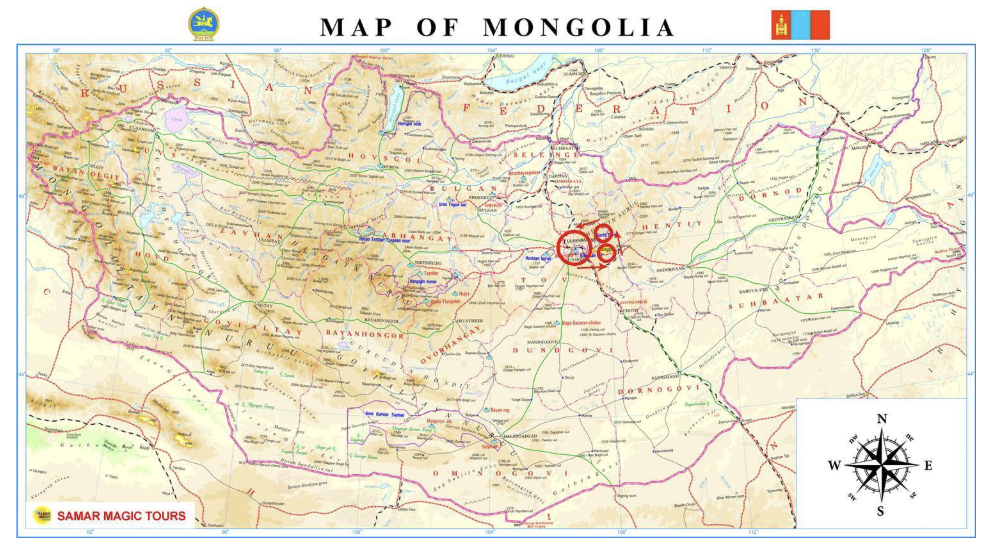
We will begin our route at the new “Genghis” Khan International Airport in Ulaanbaatar (inaugurated on July 3, 2021, located 52 km / 32.3 miles away, approximately +2-3 hours’ drive, depending on traffic), capital of Mongolia, with a warm welcome by the Samar Magic Tours team.
The Danshig Naadam Festival began to be held annually, by decree of the Mongolian Government, starting in 2025, during the last seven days of June (previously celebrated in August), in the western area of Ulaanbaatar (in a place known as Hui Doloon Khudag), approximately 35 km (18 miles) from the city.
The Danshig Naadam Festival celebrates ancient Buddhist traditions, such as the Tsam mask dance, and is dedicated to Zanabazar, the first Buddhist leader of Mongolia. “Khuree Tsam,” meaning religious mask dance, was first introduced to Mongolia in the early 18th century. Dancers wearing sacred masks perform divine movements, representing the arrival of gods and deities physically to Jambudvipa (“Earth” in Tibetan).
Visitors can attend the Naadam Festival activities, such as traditional Mongolian wrestling, horse racing, archery, and musical performances. This is an excellent opportunity to photograph Buddhist dances, national wrestling competitions, horse races, and archery contests.
The spiritual journeys to Mongolia with Samar Magic Tours focus on the experience of Tibetan Buddhism, combining the exploration of desert and mountain landscapes with visits to Mongolia’s three most important monasteries, including the “Gandan” Monastery in Ulaanbaatar. These journeys offer the chance to connect with the nomadic culture, meditate in sacred places, and learn about the Kalachakra Tantra prophecies, which evoke the ideal of
Shambhala, the hidden Buddhist kingdom.
History and Meaning of the Gandan Monastery:
Foundation: The monastery was founded in 1809.
Persecution and Restoration: It was closed during the Stalinist persecutions in 1939 but became the only active monastery in the country until 1989.
Reactivation: Beginning in 1990, it was restored and revitalized, and today it serves as an important center for Buddhism in Mongolia.
Main Attractions
Statue of Migjid Chenrezig (Avalokiteśvara), the Bodhisattva of Compassion: The most famous feature is a statue over 25 meters high of the Bodhisattva of Compassion, made of gilded bronze and adorned with precious stones.
Buildings: It houses several Tibetan-style buildings and serves as the main Buddhist study center.
Teaching Center: Gandan hosts a Buddhist university where monks study philosophy, rituals, and practices. Courses in Tibetan, Sanskrit, and English are also offered.
Religious Activities: Daily ceremonies and rituals, such as chanting and prayer, are held and open to both locals and tourists. The monastery’s prayer drums create a uniquely spiritual atmosphere.
Other Temples and Colleges: The complex includes several temples and colleges, many of which have been rebuilt and restored since the 1990s.
Cultural Environment: The monastery remains an active and vital spiritual center, offering visitors a true experience of the heart of Buddhism in Mongolia’s capital.
About the Statue of Migjid Chenrezig (Avalokiteśvara):
The original statue was made of gold and bronze and erected in 1913 through donations from Mongolians for the Bogdo Khan (the Eighth Javzandamba, who had become Emperor of Mongolia) to help him recover his eyesight. The statue stood 32 meters (105 feet) tall and symbolized Mongolia’s independence from the Manchu system. Twenty-four years later, in 1937, Soviet troops demolished it—its remains are believed to have been used to make bullets during the Siege of Leningrad.
After the democratic revolution of 1990, the government guaranteed freedom of religion. The reconstruction of the statue symbolizes the goodwill of the government and its commitment to ensuring security, freedom, and independence. The Mongolian government and people placed great importance on its rebuilding.
The Dalai Lama inaugurated the new statue of Megjid-Janraiseg (meaning “The Lord Who Looks in All Directions”) in 1996, after five years of work. This 25-meter-high statue, weighing more than 20 tons, is made from copper mined in Erdenet. It is gilded with gold donated by Nepal and Japan and wrapped in gold-embroidered brocade and over 100 kilograms (220 pounds) of silk. The statue contains 2,286 precious stones, 27 tons of medicinal plants, 334 sutras, and 2 million mantras. One thousand small statues of the deity Amitabha (Ayush) surround it. Two stone lion statues are placed nearby according to Buddhist sculptural tradition.
The Temples that Make Up the Monastery:
The first temple of the monastery was built under the initiative of Luvsanchultimjigmed Dambiijantsan, the fifth incarnation of the Bogd. Constructed by Mongolia’s finest architects, the temple was primarily made of wood and earth according to traditional Mongolian architectural concepts of that period, with roofs covered in gold. It also housed highly valuable symbolic Buddhist decorations. Many statues and images of Bodhisattvas within Gandan hold great significance. Among them are:
- A bronze statue of Zanabazar, the first living Buddha incarnation, sculpted by himself at his mother’s request;
- The Tripitaka (Gangiur), a collection of Buddhist teachings in 108 volumes;
- A silver statue of the famous Tsongkhapa of Amdo, made in the 16th century in Western Mongolia.
The Vajradhara Temple, built between 1840 and 1841, is made of stone and brick with ceramic roofs and golden decorations. On the main altar of the Dzu Temple stands a statue of Buddha and his two disciples, created in Dolon Nuur, Inner Mongolia, in the early 19th century. Religious services are held there daily.
The “Dedanprovan” building, built in the early 20th century, was originally a two-story library for the fifth incarnation of the living Buddha, Luvsanchultimjigmed Dambiijantsan. It features ceramic roofs and valuable golden decorations. In 1904, the 13th Dalai Lama stayed there. Today, this fifth building, known as the “Library,” holds more than 50,000 books and 1 million sutras written in Mongolian, Tibetan, and Sanskrit. It also preserves 16th-century surgical instruments.
The temples display the Eight Noble Symbols, Damdin Choijil, Mahayana and Hinayana representations, and sixteen Arhats crafted by Mongolian, Tibetan, and Indian artists. Embroideries and paintings depicting Bodhisattvas by Mongolian artists, as well as numerous satirical drawings and illustrations, are also found throughout the monastery.
The Dechingalav Datsan teaching center was originally located in downtown Ulaanbaatar before being rebuilt within the monastery in 1992. Every spring, this school performs the Kalachakra Ritual. Its construction began in 1800 after the Fourth Bogd Jevzundamba visited the Kalachakra Zuu Baruun Monastery in Tibet. At that time, Lkhokh Jalsrai Gegeen introduced him to the Kalachakra (Wheel of Time) philosophy. The Bogd inaugurated the Dechen Gelpa Datsan in 1801, which functioned until its closure in 1937.
When His Holiness the Dalai Lama performed a Kalachakra initiation in Varanasi, India, in 1990, he announced that the next initiation would be held in Mongolia at Gandantegchinlen Monastery. Preparations began immediately, and the datsan was reconstructed. The initiation took place in 1995. Before that, Tibetan masters visited to teach local lamas how to create a sand mandala. During the summer of 1995, the Dalai Lama visited the monastery and conducted the initiation. Since then, the Kalachakra ritual has been held annually on the 15th day of the last month of spring (lunar calendar).
The Idgachoinzinlin Teaching Center was founded by the Eighth Bogd Jevzundamba, based on the works of Tibetan scholar Sera Jebzunpa. The datsan was destroyed in 1938 but reopened in 1990 thanks to the efforts of his former disciples Tserendemchig and Naidan. A new temple was inaugurated in 2004.
The Tashchoimphel Teaching Center was established in 1756 by the Second Bogd Jebzundamba and Manjusri Khutagtu. It was destroyed in 1938 and restored in 1990; the temple was completed in 1994. The Gungaachoiling Center, founded in 1809 by the Fourth Bogd Jetsundamba, taught the works of the Tibetan scholar Panchen Sonamdagva. The datsan trained over 3,000 lamas, including renowned Mongolian masters such as Agvanrinchen, Darp Pandita, and Zava Damdin Gavju. It resumed activity in 1990 and continues to train new disciples.
The Mongolian Buddhist University, founded in 1970, combines modern education with traditional methods. It offers a four-year post-secondary program with two main divisions:
- Internal Sciences Section: Buddhist philosophy and chanting.
- General Knowledge Section: Tibetan, Sanskrit, and English languages, traditional medicine, and astrology.
The Badam Yoga Teaching Center, built in 1745 by the Second Bogd Jebzundamba, was devoted to chanting and prayer recitation. It ceased activity in 1938 and reopened in 2002 at the Geser Temple, on the eastern side of Gandan. Its main goal is to practice traditional Mongolian medicine and astrology, predicting auspicious and inauspicious dates for events. Doctors diagnose illnesses and treat patients accordingly.
The Lud Teaching Center, founded in 1739 by the Second Bogd Jebzundamba, was closed in 1938 and reopened fifty years later, in 1998. It specializes in tantric services and ritual chants.
Additionally, there are three Buddhist philosophy colleges (datsans), one of medicine and astrology, and two tantric colleges:
- Dashchoimphel College, founded in 1736 by the Second Jebtsundamba, follows the Gunchen Jamyan Shadba principle of the Tibetan Gelug tradition.
- Gungaachoilin College, founded in 1809, follows the Banchen Sodnamdagva principle.
- Idgaachoinzinlin College, founded in 1912, follows the Sera Jebtsunba principle.
- College of Medicine and Astrology, teaching traditional Mongolian medicine and astrology.
- Jud Tantric College and Kalachakra Tantric College, where students are trained in tantric Buddhist practices and rituals.
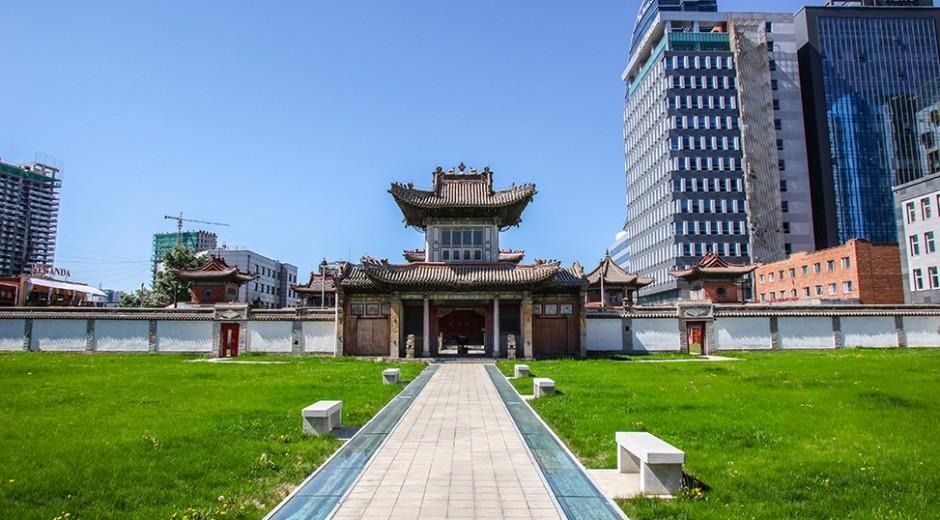
In Ulaanbaatar, we will also visit the Choijin Lama Monastery-Museum:
This monastery-museum, a masterpiece of Buddhist architecture, offers an in-depth look into Mongolian Buddhist teachings and practices. Visitors can admire its sculptures, paintings, and ritual objects, connecting with the spirituality that continues to thrive in the country today. The complex consists of six temples, originally occupied by Choijin Lama Luvsankhaidav, the brother of the Eighth Bogd Jetsun Dampa Khan, who was the State Oracle and Khutugtu of “Precious Wisdom and Clear Devotion” at the time. The complex was initiated in 1904 and completed in 1908 in honor of the State Oracle Lama Lubsanhaidub, brother of the Eighth Bogd Khan. Originally, it was a Buddhist temple complex, comprising a main temple and five subsidiary temples. It remained active until 1937, when it was closed during the height of the Stalinist repression against Buddhism and other religious traditions.
Restoration of the Yadam Temple: Faced with deterioration, one of Mongolia’s few surviving temples from the period of religious repression received international assistance for its preservation. Following the creation of a master conservation plan in collaboration with the Arts Council of Mongolia (ACM), the World Monuments Fund (WMF) organized a scientific advisory team to support the restoration of the Yadam Temple within the Choijin Lama Museum complex. This initiative also promoted local capacity building focused on traditional craftsmanship and conservation techniques.
Funded by the U.S. Ambassadors Fund for Cultural Preservation (AFCP) and the U.S. Embassy in Ulaanbaatar, restoration works began in May 2022 and concluded in October 2023, when the official inauguration ceremony took place.
The main temple features an 18th-century gilded statue of Buddha Sakyamuni, with a statue of Choijin Lama Luvsankhaidav to the Buddha’s right and the embalmed body of Baldan Choephel to his left. The temple also holds a rich collection of religious instruments, thangka paintings, silk embroideries, wood carvings, statues, and an impressive assortment of cham dance masks.
An annex within the temple contains another structure known as “Zankhang”, along with a central courtyard where Choijin Lama Luvsankhaidav performed State Oracle trance rituals.
The “Zuu” Temple, dedicated to Buddha Shakyamuni, displays papier-mâché sculptures of Buddha in his past, present, and future forms. The 16 Arhat disciples of Buddha are painted on the temple walls, accompanied by the four Maharaja protectors seated in cave-like niches on either side of the entrance.
The “Yidam” Temple served as Choijin Lama Luvsankhaidav’s private prayer temple, and was once closed to the public. It is now open for visitors. At its center stands a gilded bronze sculpture of one of the 84 Indian yogis, or Mahasiddhas. Also represented are tantric deities such as Kalachakra, Mahamaya, and Vajradhara, depicted with their shakti (consorts) in meditative postures symbolizing power and divine energy.
The fourth temple, known as the “Amugulang” or “Peace” Temple, is dedicated to the first Mongolian reincarnation of Bogd Jevzundamba, Öndör Gegeen Zanabazar.
The Choijin Lama Monastery-Museum preserves a rich collection of Buddhist artifacts. During Mongolia’s monastic golden age, nearly 700 monasteries were built, yet the Choijin Lama Temple stands out for its distinctive history and artistic character. It represents a sublime legacy of Mongolian craftsmanship, fine arts, and sculpture from the late 19th and early 20th centuries. Located in central Ulaanbaatar, directly south of Sukhbaatar Square, the museum is open year-round (with reduced hours during winter months).
The explanations of the almost overwhelming collection are not as detailed as they could be, but each temple has room attendants who can provide additional information.
The museum itself, along with its exhibits, also reflects the revival of Buddhism in Mongolia after communist repression, featuring a particularly fascinating exhibition on the Buddhist cham dance and its modern-day resurgence.
Departure westward to a place known as Hui Doloon Hudag, approximately 35 km (18 miles) from Ulaanbaatar. Here, you will have the opportunity to enjoy and observe the mythical Tsam dance ceremony, as well as several Buddhist rituals.
The Danshig Naadam Festival celebrates ancient Buddhist traditions, such as the Tsam masked dance, and is dedicated to Mongolia’s first Buddhist leader, Zanabazar. “Khuree Tsam,” meaning “religious mask dance,” was first introduced to Mongolia in the early 18th century. Dancers wearing elaborate masks perform the movements of gods and deities, as if the divine beings had physically descended upon Jambudvipa (“earth” in Tibetan).
During the festival, visitors can also witness traditional Naadam Festival events, including Mongolian wrestling, horse racing, archery, and musical performances. This is an excellent opportunity to photograph the Buddhist dances, as well as the traditional Mongolian wrestling matches, horse races, and archery contests.
Additionally, an Authentic Mongolian Nomadic Show takes place, showcasing the traditional lifestyle of Mongolian nomads—their herding practices, and the use of the five types of livestock as they move from one pasture to another, using ox carts, yaks, camels, and horses.
In the final part of this grand journey, we will head northeast to visit the Great Equestrian Statue of Genghis Khan. The statue symbolically faces east, toward his birthplace in Khentii Province.
At the base of the monumental complex stands a 10-meter-high visitor center, featuring 36 columns representing the 36 Khans descended from Ligdan Khan. The statue was inaugurated in 2008. Visitors can ascend through the horse’s chest and neck to reach its head, where a panoramic view of the surrounding landscape awaits.
The area around the main statue is planned to be surrounded by 200 designed Gers (still under construction), arranged following the hoofprint pattern used by Mongol tribes in the 13th century.
The museum inside the complex features exhibitions related to the Bronze Age and Xiongnu archaeological cultures of Mongolia, showcasing everyday utensils, belt buckles, knives, and sacred animal depictions, among others. A second exhibition highlights the great Khan period (13th–14th centuries), displaying ancient tools, fine metalwork, and several Nestorian crosses and rosaries. Adjacent to the museum lies a tourist recreation center spanning 212 hectares. At the base of the statue, visitors can see a replica of the legendary Golden Whip of the
Great Khan. Nearby, visitors can take beautiful photos with Kazakh falconers and their Golden Eagles, enjoy rides on Bactrian camels or Mongolian horses across the steppes, and even try traditional archery (additional cost, payable on-site).
Next, departure toward the Gorkhi/Terelj National Park, located in the northeast at an altitude of 1,600 meters above sea level, featuring towering Mesozoic granite formations, mountains, steppes, alpine forests, and vast rocky structures with curious shapes dating from the Mesozoic era — such as the Turtle Rock or the Monk Reading a Book formation.
Declared a National Park in 1990, Gorkhi/Terelj covers an area of approximately 300,000 hectares. There will be a stop to take photos, purchase souvenirs, and enjoy an easy hike to the large Turtle Rock, the symbol of the park.
A gentle walk leads to the Arryabal Meditation Temple, a Buddhist meditation center located on a mountainside, notable for its 108 steps that lead to the temple, a gallery with Buddhist paintings, and a thangka depicting the myth of Shambhala, all situated atop a hill.
The Steps: There are 108 steps, symbolizing the number 108 as an auspicious figure in Buddhism, as well as representing the trunk of an elephant.
Gallery of Buddhist Philosophy: On the ground floor, visitors can view 220 paintings by Bayantsagaan, illustrating various Buddhist beliefs.
Main Temple: Dedicated to the Kalachakra philosophy (the “Wheel of Time”), it houses a thangka depicting the myth of Shambhala and a Kalachakra mandala.
Buddha Sculpture: A modern sculpture of Buddha is carved into the rock of a nearby hill, completing the spiritual and serene atmosphere of this sacred site.