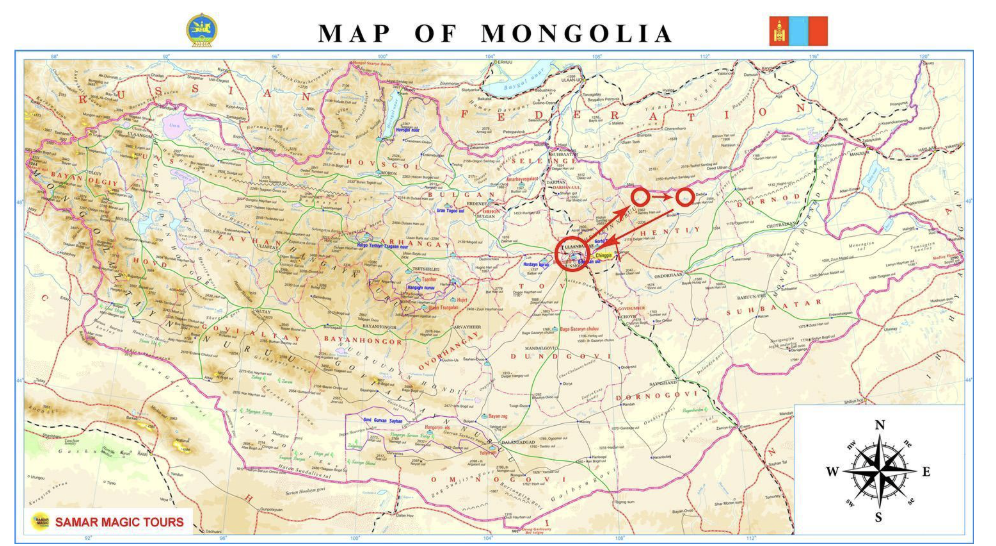
We will begin the route at the new “Genghis” Khan airport of Ulaanbaatar (inaugurated on July 3, 2021, located 52 km / 32.3 miles away, approximately 2 hours by car, depending on traffic), the capital of Mongolia, with a warm reception by the Samar Magic Tours team.
Spiritual journeys to Mongolia with Samar Magic Tours focus on the experience of Tibetan Buddhism, combining the exploration of desert and mountain landscapes with visits to Mongolia’s three most important monasteries, such as the “Gandan” Monastery in Ulaanbaatar. These journeys offer the opportunity to connect with the nomadic culture, meditate in sacred places, and learn about the prophecies of the Kalachakra Tantra, which invoke the ideal of Shambhala as a hidden Buddhist kingdom.
– In the first part of this great journey, we will visit the “Gandantegchinlin” Monastery, or “Gandan” Monastery, a historic Buddhist monastery in Ulaanbaatar known as the “Great Place of Absolute Joy.” Founded in 1809, it was the only active monastery in the country between 1944 and 1989 and currently houses several hundred monks, serving as the center of Buddhism in Mongolia. Its main attraction is an impressive 25-meter-high statue. Inside, you can witness traditional Buddhist ceremonies, including collective prayers, mantras, and meditation rituals aimed at achieving inner peace and spiritual balance.
History and Meaning of the Gandan Monastery:
Foundation: The monastery was founded in 1809.
Persecution and Restoration: It was closed during the Stalinist persecutions in 1939 but became the only active monastery in the country until 1989.
Reactivation: Beginning in 1990, it was restored and revitalized, and today it serves as an important center for Buddhism in Mongolia.
Main Attractions
Statue of Migjid Chenrezig (Avalokiteśvara), the Bodhisattva of Compassion: The most famous feature is a statue over 25 meters high of the Bodhisattva of Compassion, made of gilded bronze and adorned with precious stones.
Buildings: It houses several Tibetan-style buildings and serves as the main Buddhist study center.
Teaching Center: Gandan hosts a Buddhist university where monks study philosophy, rituals, and practices. Courses in Tibetan, Sanskrit, and English are also offered.
Religious Activities: Daily ceremonies and rituals, such as chanting and prayer, are held and open to both locals and tourists. The monastery’s prayer drums create a uniquely spiritual atmosphere.
Other Temples and Colleges: The complex includes several temples and colleges, many of which have been rebuilt and restored since the 1990s.
Cultural Environment: The monastery remains an active and vital spiritual center, offering visitors a true experience of the heart of Buddhism in Mongolia’s capital.
About the Statue of Migjid Chenrezig (Avalokiteśvara):
The original statue was made of gold and bronze and erected in 1913 through donations from Mongolians for the Bogdo Khan (the Eighth Javzandamba, who had become Emperor of Mongolia) to help him recover his eyesight. The statue stood 32 meters (105 feet) tall and symbolized Mongolia’s independence from the Manchu system. Twenty-four years later, in 1937, Soviet troops demolished it—its remains are believed to have been used to make bullets during the Siege of Leningrad.
After the democratic revolution of 1990, the government guaranteed freedom of religion. The reconstruction of the statue symbolizes the goodwill of the government and its commitment to ensuring security, freedom, and independence. The Mongolian government and people placed great importance on its rebuilding.
The Dalai Lama inaugurated the new statue of Megjid-Janraiseg (meaning “The Lord Who Looks in All Directions”) in 1996, after five years of work. This 25-meter-high statue, weighing more than 20 tons, is made from copper mined in Erdenet. It is gilded with gold donated by Nepal and Japan and wrapped in gold-embroidered brocade and over 100 kilograms (220 pounds) of silk. The statue contains 2,286 precious stones, 27 tons of medicinal plants, 334 sutras, and 2 million mantras. One thousand small statues of the deity Amitabha (Ayush) surround it. Two stone lion statues are placed nearby according to Buddhist sculptural tradition.