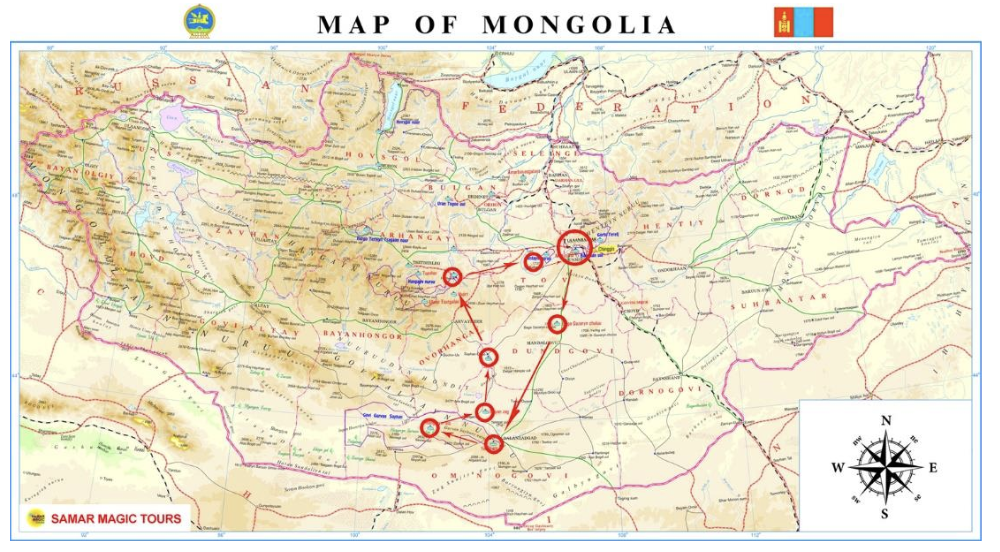
We will begin our journey at the new Genghis Khaan airport in Ulaanbaatar (opened on July 3, 2021; located 52 km / 32.3 miles away, a +2 hour drive), the capital of Mongolia, where you will be welcomed by the Samar Magic Tours team. This is the most compelling major route in Mongolia, covering over 2,500 km (1,553.4 miles).
By decree of the Mongolian government, the Danshig Naadam Festival is held annually during the last seven days of June (previously, it took place in August) at a site known as Khui Doloon Khudag, located approximately 35 km (18 miles) west of Ulaanbaatar. The Danshig Naadam Festival celebrates ancient Buddhist traditions—such as the Tsam dance—and is dedicated to Mongolia’s first Buddhist leader, Zanabazar. “Khuree Tsam,” a form of religious masked dance, was first introduced to Mongolia in the early 18th century. Dancers wearing masks embody various gods and deities, as if these divine beings had physically descended to Jambudvipa (“Earth” in Tibetan). You will have the opportunity to attend Naadam Festival events, including Mongolian wrestling, horse racing, and archery, as well as musical performances. It is an excellent occasion to photograph Buddhist dances, national Mongolian wrestling competitions, horse races, and archery contests. Next, we head northeast to visit the Great Equestrian Statue of Genghis Khan. At the base of the statue, visitors can see a replica of the Great Khan’s legendary golden whip. Tourists can take an elevator up inside the statue, emerging near Genghis Khan’s crotch; from there, one can walk toward the horse’s head to enjoy a sweeping panoramic view of the steppe. We will also visit a small Bronze Age museum located in the basement of the statue. Afterward, we depart for Gorkhi-Terelj National Park, situated at an altitude of 1,600 meters above sea level. The park features towering Mesozoic granite cliffs, mountains, steppes, and alpine forests, along with striking, uniquely shaped Mesozoic rock formations—such as “Turtle Rock”. It lies at the foothills of the Khentii Mountains, the region where Genghis Khan was born. Established as a national park in 1993, it spans an area of 300,000 hectares.
Next, we head south toward the rock formations of Baga Gazarin Chuluu (which means “rocks” in Mongolian)—a collection of granite rock formations in the Middle Gobi, reaching an elevation of 1,768 meters and spanning 15 km in length and 10 km in width. It is said that Genghis Khan once camped here during one of his journeys. Upon arrival, you will check into your accommodation. After some time to rest, we will set out on an excursion to the ruins of the Sum Khunkh Burd temple, which dates back to the 10th century. In the Middle Gobi, we will also explore Tsagaan Suvarga (“White Stupas/Pagodas”), located approximately 426 km (265 miles) from Ulaanbaatar and 30 km east of the main Ulaanbaatar–South Gobi (Umnugobi) road. This colorful limestone formation—standing 30–60 meters (98–197 feet) high and stretching 400 meters (1,312 feet) long—was once an ancient seabed, where visitors can still find marine fossils and seashells. The colors are particularly striking in the morning and evening. Tsagaan Suvarga gets its name from its resemblance to Buddhist stupas or pagodas. There are trails that allow you to hike down into and back up through the cliffs, offering a perfect opportunity to photograph the vibrant colors during the morning and evening hours.
Next, we head south toward the fascinating Gobi Desert. We will explore the “Yolyn” Canyon—also known as the Vulture Gorge—within Gobi Gurvan Saikhan National Park (named for its three mountain ranges: the eastern, central, and western “beauties”). We will also visit sites where fossils of giant dinosaurs have been discovered, as well as the beautiful “Moltsog” sand dunes. We will spend time with a family that raises Bactrian camels and have the opportunity to go for a ride on one. In central Mongolia, we will visit Karakorum—the ancient capital of Genghis Khan’s Mongol Empire—and explore the Orkhon Valley, which was designated a UNESCO World Heritage Site in 2004 for its representation of nomadic pastoral traditions that have evolved over more than two millennia. We will also explore the beautiful Lake Ugii, a prime habitat for various bird species, including swans, geese, cranes, ducks, pigeons, storks, and other migratory birds.
A large portion of the Mongolian population remains nomadic, moving from place to place on horseback, by camel, or by yak, accompanied by their gers (yurts) and livestock. An encounter with one of these families and a glimpse into their way of life is an unforgettable experience. To fully enjoy this, one must be prepared to accept the conditions mentioned above, set aside preconceived notions about how things “should” be according to one’s own cultural mindset, and remain open to everything this country has to offer.